
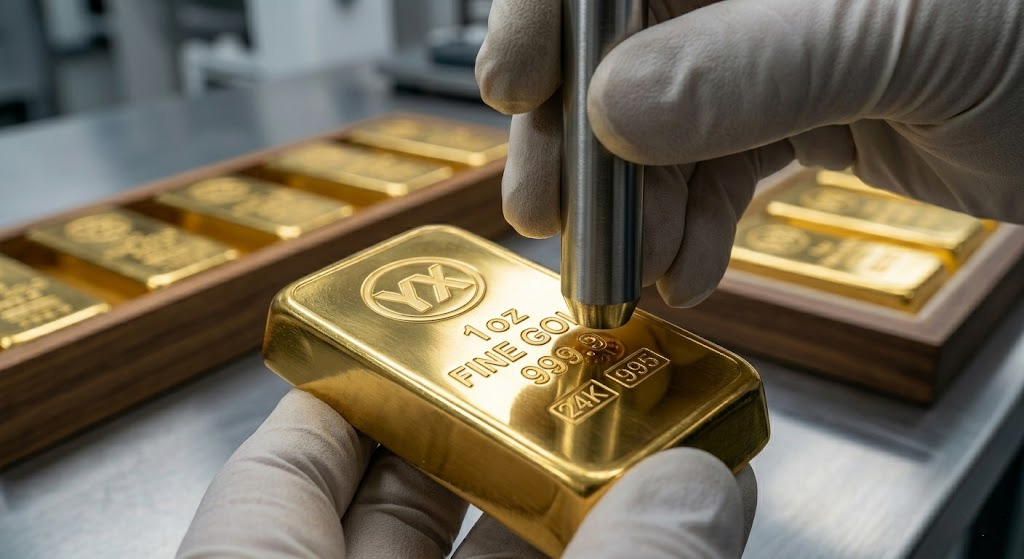
You can authenticate gold by performing a series of visual, physical, and chemical tests ranging from hallmark inspection to specific gravity measurements. In a global market where counterfeit techniques grow increasingly sophisticated, the risk of purchasing “fool’s gold” is higher than ever before. Falling victim to a gold scam doesn’t just result in a minor financial setback; it can jeopardize your business reputation or deplete a lifetime of personal savings in an instant. Mastering how to authenticate gold is the only way to safeguard your assets and trade with absolute confidence in any environment. Our comprehensive guide provides the technical expertise and procedural standards you need to ensure every ounce in your collection is genuine.
Why is learning how to authenticate gold vital today?
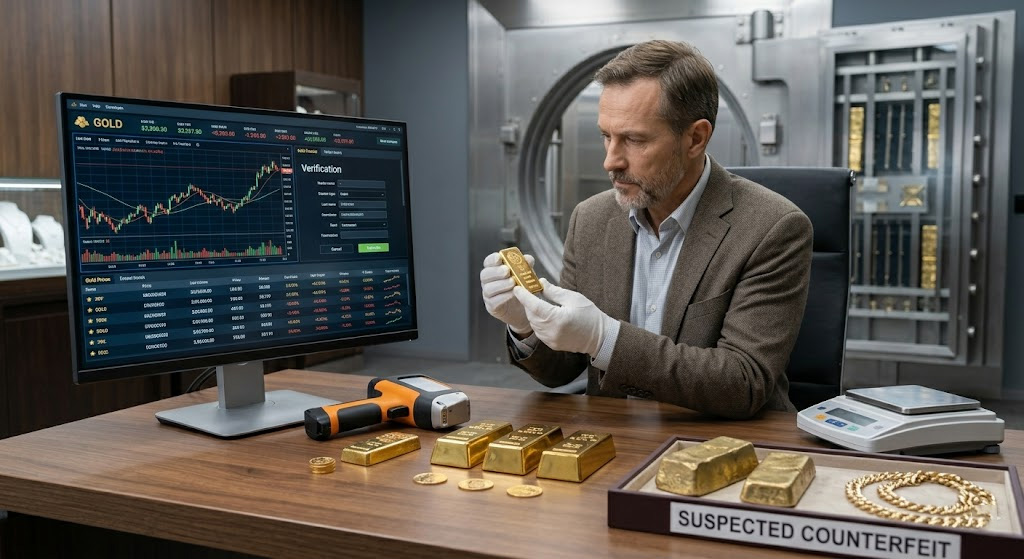
It is vital because market volatility and advanced counterfeiting techniques make verified assets the only hedge against financial fraud. Mastering how to authenticate gold ensures that you protect your capital and maintain your business reputation among elite clientele.
Why does gold authentication matter?
Gold is a high-value asset that attracts sophisticated criminals who use tungsten or copper cores to mimic weight. Without proper testing, you might unknowingly stock or sell fraudulent items that could lead to legal liabilities.
Think about it:
- Counterfeit rates have spiked in the last five years.
- Imitation metals are now coated with thicker layers of real gold.
- Professional labs report higher volumes of “super-fakes” in the market.
What are the financial risks?
Purchasing counterfeit bullion can result in a total loss of investment capital since these items have zero resale value in professional circles. For a B2B jewelry enterprise, even one fake piece can lead to a devastating loss of trust from wholesale partners.
How do scams impact the jewelry market?
Scams drive down consumer confidence and force retailers to implement more expensive security protocols to verify their inventory. By knowing how to identify real gold, you position yourself as a leader in quality control and market integrity.
Key Takeaway: Authentication is the primary defense against the financial and reputational damage caused by modern counterfeiters.
| Risk Factor | Impact Level | Mitigation Strategy | |
|---|---|---|---|
| Financial Loss | High | Multi-stage authentication protocols | |
| Reputation Damage | Extreme | Professional certification and tools | |
| Legal Liability | Moderate | Documented verification at purchase |
The current market environment necessitates a proactive approach to verification to maintain profitability and brand standing.
What hallmarks help in how to authenticate gold?
Hallmarks act as a legal certification of purity and origin stamped directly onto the metal surfaces. Understanding how to authenticate gold through these markings is the first step in identifying karat weight and manufacturing source.
Understanding the karat system
The karat system indicates the ratio of pure gold to alloyed metals, where 24K is pure and 14K contains 58.3% gold. These stamps are usually found on the inside of rings or on the clasps of chains.
Here is the kicker:
- 24K means 99.9% purity.
- 18K means 75% purity.
- 14K means 58.3% purity.
- 10K means 41.7% purity.
Deciphering regional differences?
US manufacturers typically use karat marks like 14K, while European makers often use three-digit fineness marks like 585. Knowing these variations helps you verify international inventory without confusion or delay.
What do GP and GF markings mean?
Stamps like GP (Gold Plated) or GF (Gold Filled) signify that the item is not solid gold but a base metal with a surface layer. If you see these marks, the item’s intrinsic metal value is significantly lower than solid gold.
Key Takeaway: Hallmarks provide a “birth certificate” for gold, but they must be verified alongside physical tests to ensure they aren’t forged.
| Mark Type | Meaning | Real Gold Content | |
|---|---|---|---|
| 18K / 750 | Solid 18 Karat | 75% | |
| 14K / 585 | Solid 14 Karat | 58.5% | |
| GP / HGE | Gold Plated | Trace Only |
Identifying these stamps quickly allows for the rapid sorting of inventory before more intensive testing begins.
Which visual signs assist how to authenticate gold?
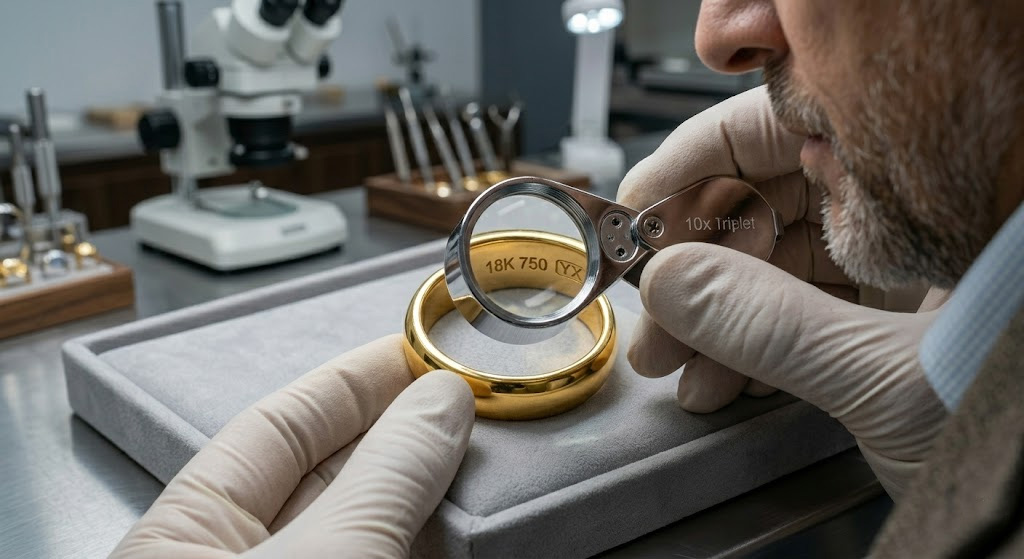
Visual inspection is the quickest first step and allows you to identify obvious red flags before using chemical agents. When considering how to authenticate gold, you must look for inconsistencies in color, luster, and signs of wear that reveal base metals.
Inspecting stamps and marks
Use a professional jeweler’s loupe to inspect the crispness of the hallmark and the manufacturer’s logo. Authentic stamps should be clean and precise, whereas counterfeit stamps often appear smudged or unevenly applied.
It gets better:
- Loupes reveal hidden surface fractures.
- Consistent color in crevices suggests solid metal.
- Sharp edges on stamps indicate high-quality casting.
Identifying wear and fading?
Look closely at high-friction areas like the edges of links or the bottom of a ring shank. If you see a different color peeking through, such as silver or orange, it is a clear sign of gold plating.
Using a jeweler’s loupe for clarity
A loupe allows you to see the “orange peel” texture often found in poor-quality fakes or the seam lines of casted imitations. This level of detail is essential for verifying high-value heirlooms or vintage jewelry pieces.
Key Takeaway: A thorough visual exam with high-magnification tools can catch many fakes before you even open a test kit.
| Visual Cue | Authentic Sign | Red Flag | |
|---|---|---|---|
| Surface Color | Uniform and rich | Fading or greenish tint | |
| Stamp Quality | Sharp and centered | Blurry or off-center | |
| High-Wear Areas | Same color throughout | Different metal visible |
Professional visual screening saves time by filtering out low-quality counterfeits immediately during the intake process.
Can physical tests show how to authenticate gold?
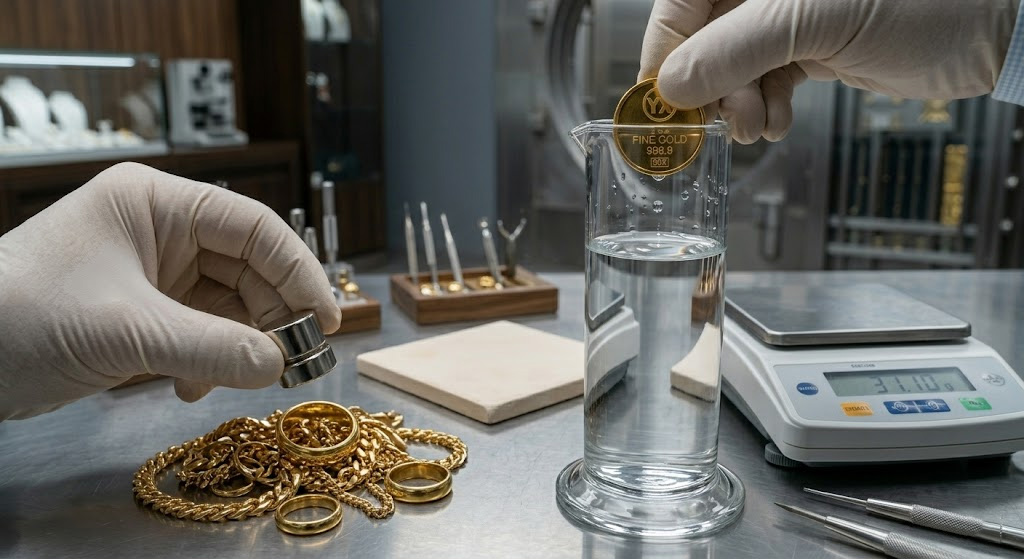
Physical interaction with the metal provides immediate clues about its density and magnetic properties. For example, knowing how to authenticate gold involves testing if the metal reacts to high-strength magnets or behaves correctly in water.
Performing the magnet test
Real gold is non-magnetic and will not react even to the strongest neodymium magnets. If the item sticks to the magnet, it likely has a core of iron, nickel, or steel.
The best part?
- Magnets are inexpensive and portable.
- They provide an instant “yes/no” result.
- This test is completely non-destructive.
- It works through thin layers of plating.
The float test: observing density
Gold is one of the densest metals and should sink rapidly to the bottom of a water container. If the item floats, stays suspended, or sinks slowly, it is composed of much lighter, non-precious alloys.
Is the ceramic scratch test reliable?
By dragging the gold across an unglazed ceramic tile, you can check the color of the streak it leaves behind. A gold-colored streak confirms authenticity, while a black or brown streak indicates a base metal imitation.
Key Takeaway: Physical tests exploit the unique scientific properties of gold—like density and magnetism—to reveal its true nature.
| Physical Test | Expected Result (Real) | Failure Result (Fake) | |
|---|---|---|---|
| Magnetism | No reaction | Attracts to magnet | |
| Float Test | Sinks instantly | Floats or sinks slowly | |
| Ceramic Scratch | Gold streak | Black/Brown streak |
These non-invasive methods are the cornerstone of at-home and small-business verification because they require minimal equipment.
Are chemical steps used in how to authenticate gold?
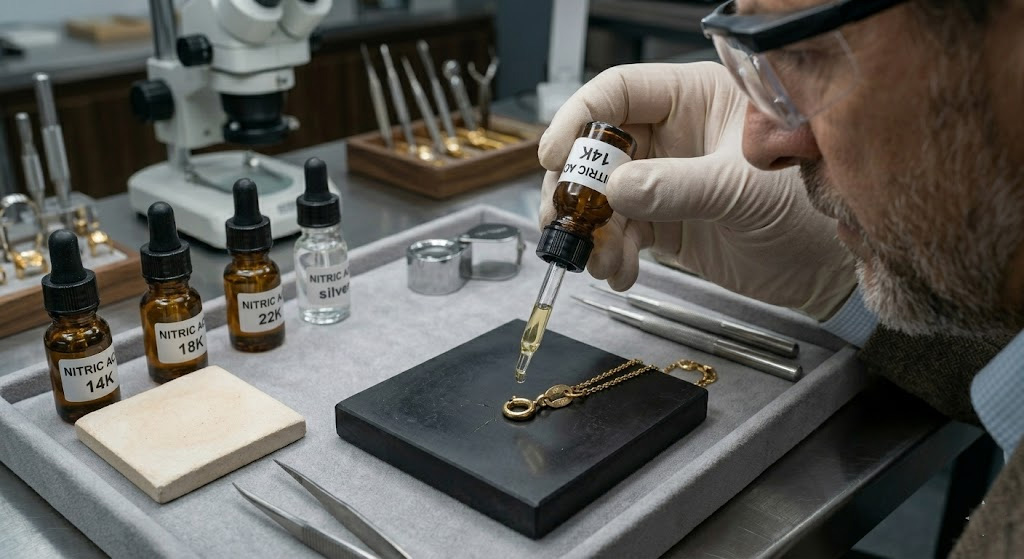
Chemical reactions provide a definitive answer regarding metal purity by testing how the surface reacts to acidic compounds. Learning how to authenticate gold using the nitric acid test allows you to verify the exact karat level of a piece.
Using nitric acid for purity
The nitric acid test involves applying a small drop of acid to a tiny scratch on the item to see if it changes color. Different strengths of acid are used to verify 10K, 14K, 18K, and 22K gold purities accurately.
Believe it or not:
- Gold resists most common acids.
- Green reactions indicate base metals.
- Milky reactions suggest silver plating.
X-ray fluorescence (XRF) testing
XRF technology uses x-rays to determine the exact elemental breakdown of a metal piece without causing any damage. This is the gold standard for B2B transactions where precision is required for large-scale bullion or jewelry batches.
Calculating specific gravity
This advanced physical-chemical method involves weighing the item in air and then in water to calculate its displacement. Because gold’s density is so specific, this calculation is almost impossible for counterfeiters to fake accurately.
Key Takeaway: Chemical and electronic testing provides the highest level of certainty and is required for all high-value transactions.
| Chemical Tool | Precision Level | Portability | |
|---|---|---|---|
| Acid Test Kit | Moderate | High | |
| XRF Scanner | Extreme | Low/Moderate | |
| Electronic Tester | High | High |
Utilizing chemical verification ensures that your inventory meets the strict purity standards expected in the professional jewelry industry.
Does jewelry change how to authenticate gold?
Testing a finished piece of jewelry requires more care than testing a raw bar to avoid damaging the design. Whether you are dealing with a piece from a specialized ring box or a simple chain, the construction dictates which methods are safest.
The ping test for bars and coins
If you tap a solid gold coin or bar with another metal object, it should emit a long, high-pitched ringing sound. Fakes made of lead or other dull metals will produce a short, flat “thud” instead of a ring.
Think about it:
- Resonance is a property of purity.
- Ping testing is used by bullion dealers.
- It works best for uniform shapes.
- No chemicals are required for this.
Verifying manufacturer serial numbers
Most high-end jewelry and investment-grade bars come with unique serial numbers etched into the surface. You can verify these numbers through the manufacturer’s database to ensure the piece’s provenance and authenticity.
Checking security features?
Modern gold bars often include holographic elements or micro-engravings that are difficult for scammers to replicate. Inspecting these under a microscope provides an extra layer of security for bulk bullion purchases.
Key Takeaway: Jewelry authentication must account for stones, solder points, and intricate designs that might interfere with standard tests.
| Jewelry Type | Best Test Method | Consideration | |
|---|---|---|---|
| Solid Rings | Acid or Electronic | Test the inner shank | |
| Hollow Chains | Magnet or Specific Gravity | Watch for internal solder | |
| Bullion Bars | Ping or Ultrasound | Verify serial numbers |
Adapting your testing strategy to the specific form of the gold ensures more accurate results while preserving the item’s aesthetic value.
Can tech apps improve how to authenticate gold?
Modern technology offers innovative ways to verify assets through smartphone software and specialized hardware. In the digital age, knowing how to authenticate gold means utilizing image recognition and ultrasound waves to detect internal inconsistencies.
Smartphone image recognition tools
Some apps allow you to scan the dimensions and weight of a coin or bar to check if they match official mint specifications. While not a standalone proof, these apps are excellent for a quick field check during a purchase.
Keep this in mind:
- Apps compare dimensions to databases.
- They can detect “thick” coins.
- Visual AI spots fake mint marks.
Using ultrasound for inspection?
Ultrasound devices send sound waves through a gold bar to check if the core is consistent with the surface. This is the only way to detect a tungsten-filled bar without cutting it in half or using expensive XRF machines.
Key Takeaway: Technology bridges the gap between simple at-home tests and professional laboratory analysis.
| Tech Tool | Function | Best For | |
|---|---|---|---|
| Mobile Apps | Spec Verification | Coins and Bullion | |
| Ultrasound | Core Inspection | Thick Gold Bars | |
| Digital Scales | Precision Weighing | All Gold Types |
Integrating tech-based solutions into your workflow reduces human error and provides a modern “paper trail” for verified assets.
How to authenticate gold and avoid common scams?
Scammers often rely on high-pressure sales tactics and “too good to be true” prices to bypass your logical checks. Beyond the initial presentation, knowing how to authenticate gold involves verifying the dealer’s history and spotting classic “bait and switch” maneuvers.
Common counterfeit tactics
One common tactic is selling “gold” jewelry that is actually heavy brass or copper with a thick 24K plating. Another is using authentic packaging or boxes to hide a fraudulent item inside.
Watch for these:
- Unusually low prices.
- Pressure to buy quickly.
- Lack of return policies.
- Refusal to allow testing.
Spotting unreliable online dealers?
Always check for a physical business address and verifiable reviews before sending large payments to an online seller. Authentic B2B dealers will always provide certificates of authenticity and be open to third-party appraisals.
Key Takeaway: Awareness of scam patterns is just as important as the technical ability to test the metal itself.
| Scam Type | Description | Prevention | |
|---|---|---|---|
| Heavy Plating | Thick gold over base metal | Deep acid or magnet test | |
| Fake Hallmarks | 14K stamp on brass | Loupe and acid check | |
| Fraudulent Bars | Tungsten core bullion | Ultrasound or Ping test |
Maintaining a skeptical mindset and following a strict testing protocol will keep you safe from the most common market traps.
When do pros show you how to authenticate gold?
There are moments when at-home testing reaches its limits and the value of the asset demands a certified expert’s touch. If you are unsure how to authenticate gold for a multi-million dollar transaction or a rare heirloom, seeking a professional appraiser is the only path.
Benefits of a professional appraisal
Professional appraisers provide a legal document that certifies the metal content, weight, and current market value of your piece. This documentation is essential for insurance coverage and for selling gold to high-end auction houses.
Here is the kicker:
- Pros use $20,000+ XRF machines.
- They have access to mint records.
- Their reports are legally binding.
- They can identify rare alloys.
Expert tools vs. at-home methods?
While a magnet test is helpful, a professional uses a combination of ultrasound, spectroscopy, and precision mass scales. These tools eliminate the “gray area” that can occur with subjective visual or chemical testing.
Key Takeaway: High-value assets require the certainty that only professional-grade equipment and expertise can provide.
| Professional Tool | Advantage | Cost vs At-Home | |
|---|---|---|---|
| XRF Spectrometer | Total metal breakdown | Significant Investment | |
| Precision Scales | 0.001g Accuracy | Higher Cost | |
| Certified Appraiser | Legal Certainty | Service Fee |
Leveraging professional services for your most valuable pieces ensures that your entire portfolio is backed by credible, third-party verification.
What tools help you in how to authenticate gold?
Building a testing kit is an essential investment for any professional jeweler or serious collector. To master how to authenticate gold, you need a collection of reliable tools that allow you to perform a full spectrum of tests at a moment’s notice.
Essential kits for home testing
A basic kit should include a set of testing acids, a ceramic stone, a powerful magnet, and a 10x or 20x jeweler’s loupe. These items are portable and provide enough data to catch 95% of common counterfeits in the market.
Make sure you have:
- A set of 10K, 14K, 18K, 22K acids.
- A high-quality unglazed touchstone.
- A digital scale with “gram” and “pennyweight” modes.
- Protective gloves and eyewear.
Protecting assets with secure storage?
Once gold is authenticated, it must be stored in a way that prevents tarnish and unauthorized handling. Using high-quality packaging and secure boxes not only protects the metal but also maintains the premium presentation of your brand.
Key Takeaway: The quality of your results depends entirely on the quality and maintenance of your authentication tools.
| Essential Tool | Primary Purpose | Necessity | |
|---|---|---|---|
| Acid Test Kit | Purity Verification | Essential | |
| Digital Scale | Weight Consistency | Essential | |
| Jeweler’s Loupe | Visual Inspection | Essential |
Equipping yourself with these professional-grade supplies allows you to act as your own gatekeeper against fraud in the precious metals market.
Frequently Asked Questions
Can I use vinegar to test if gold is real?No, vinegar is not a professional standard and can lead to false results or damage to certain jewelry alloys. Use a dedicated nitric acid kit for accurate chemical verification.
What’s the best way to test gold without damaging it?The best non-destructive methods are the magnet test, the float test, and electronic or XRF testing. These methods allow you to verify the metal without scratching or applying acid to the surface.
How do I know if my 14k gold is authentic?Check for a “14K” or “585” stamp, perform a magnet test, and then use a 14K-strength acid test on a touchstone for confirmation. If it passes all three, it is almost certainly authentic.
Can I use a common refrigerator magnet?No, refrigerator magnets are usually too weak to detect low-grade magnetic cores. You should use a high-strength neodymium magnet for a reliable authentication check.
How do I know if a hallmark is fake?Look for blurry edges, uneven depths, or misspellings under a 10x jeweler’s loupe. If the hallmark looks “stamped in” roughly rather than precisely engraved, it is a significant red flag.
Conclusion
Authenticating your gold collection is a fundamental skill for any serious professional, solved by the rigorous application of visual, physical, and chemical standards. We have explored everything from the basics of hallmarks to the advanced precision of XRF scanning to ensure you are never a victim of market fraud. By mastering these techniques, you move from a position of vulnerability to one of absolute authority in the precious metals space.
Our mission is to help you build a brand that stands for integrity, whether through providing the knowledge to verify your assets or the premium packaging to protect them. Ready to enhance your brand’s security and showcase your verified collection with the excellence it deserves? Contact us today to find the perfect professional packaging and tool solutions that define your success in the luxury market. Your gold deserves a presentation that reflects its true value.