
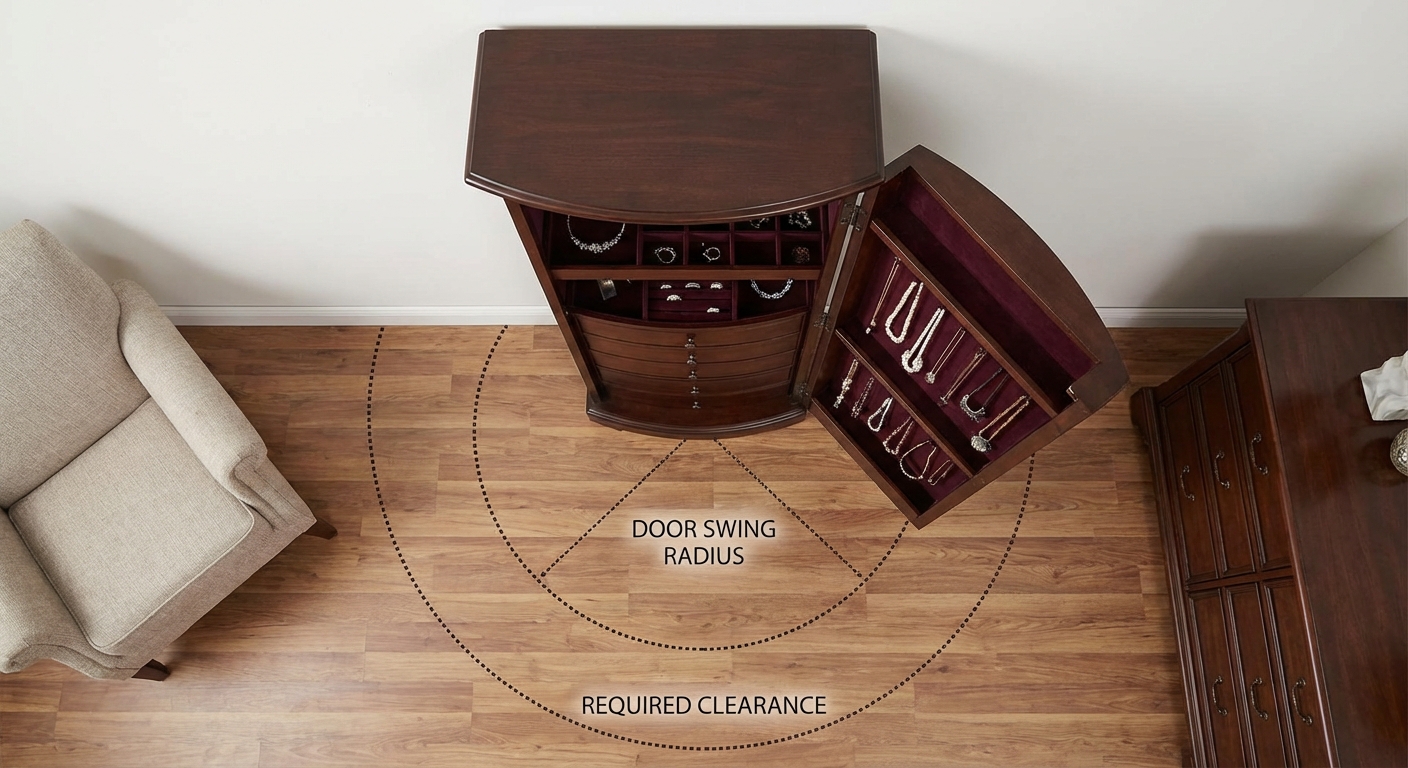
To learn how to measure for a jewelry armoire, you must record the height, width, and depth of your available floor space while accounting for door and lid clearances. Finding the right storage for a luxury collection is difficult when standard furniture dimensions don’t match your room’s layout. Nothing is more frustrating than purchasing a high-end piece only to realize the side doors won’t open or the lid hits your wall art. By mastering How to Measure for a Jewelry Armoire , you can ensure your investment fits perfectly and provides the seamless organization your inventory deserves.
Ready to learn How to Measure for a Jewelry Armoire?

To learn How to Measure for a Jewelry Armoire, start by gathering a metal tape measure and marking your intended floor space with painter’s tape. This physical outline helps you visualize the footprint within your current room flow. Professional precision ensures that the unit doesn’t look cramped or out of place.
Why is precision the key to an organized room?
Look: A misplaced armoire can disrupt the entire ergonomics of a dressing area. If you don’t measure correctly, you risk blocking traffic paths or interfering with existing furniture.
- Prevents returns of heavy furniture items.
- Protects the armoire from being bumped in high-traffic areas.
- Ensures all drawers function as intended by the manufacturer.
What tools do you need to get started today?
Here is the deal: You only need a few basic tools to get professional-grade results. Accuracy at this stage saves hours of frustration during the delivery and setup process.
- Retractable steel tape measure.
- Painter’s tape or masking tape.
- A notepad or digital measuring app.
Key Takeaway: Preparation is half the battle; having the right tools and a physical floor marker prevents common spatial errors before you even shop.
| Tool | Purpose | Recommended Type | |
|---|---|---|---|
| Tape Measure | Recording exact dimensions | Steel (non-stretch) | |
| Painter’s Tape | Visualizing floor footprint | Low-tack adhesive | |
| Level | Checking floor stability | 2-foot spirit level |
This initial setup phase creates a reliable baseline for all subsequent measurements and placement decisions.
Which type changes How to Measure for a Jewelry Armoire?

The mounting style—freestanding, wall-mounted, or over-the-door—determines which specific dimensions you need to prioritize when learning How to Measure for a Jewelry Armoire . Each design interacts with your room’s architecture differently, shifting the focus from floor space to wall clearance.
Is a freestanding or wall-mounted unit better?
The best part? Choosing between these two depends entirely on your available square footage and wall strength. Freestanding units require floor space, while wall-mounted options save floor area but need vertical clearance.
- Freestanding: Needs floor clearance on all sides.
- Wall-mounted: Requires stud finding and vertical swing space.
Have you considered an over-the-door model?
Look: Over-the-door models are the ultimate space savers for compact rooms or apartments. However, you must measure the door’s thickness and the weight-bearing capacity of the hinges.
- Measure door thickness (usually 1.5 to 2 inches).
- Check for clearance between the door top and the frame.
Key Takeaway: Identifying your armoire type first dictates whether you are measuring for floor depth or wall height.
| Armoire Type | Primary Measurement Needed | Space Consideration | |
|---|---|---|---|
| Freestanding | Floor footprint (W x D) | High-traffic impact | |
| Wall-Mounted | Vertical wall height | Stud placement | |
| Over-the-Door | Door thickness & gap | Hinge weight limits |
Selecting the right category allows you to narrow your focus to the measurements that truly impact the unit’s functionality.
Does height matter for How to Measure for a Jewelry Armoire?

Yes, height is critical because you must ensure the top lid can open fully without hitting mirrors or wall-mounted decor when determining How to Measure for a Jewelry Armoire. Many premium armoires feature a “lift-top” design that hides a vanity mirror, adding significant vertical inches.
Will your piece sit comfortably under wall art?
The reality? Most users forget to account for the items already hanging on their walls. If your armoire is too tall, you might have to relocate paintings or sconces.
- Measure from the floor to the bottom of wall decor.
- Allow a 2-inch “buffer zone” for visual balance.
Is there enough room for a lift-top mirror?
Here is the deal: The total height listed in product specs usually refers to the unit when closed. You must find the “open height” to ensure the lid doesn’t strike the wall.
- Calculate the lid length and add it to the base height.
- Check for ceiling fan or light fixture interference.
Key Takeaway: Height isn’t just about the floor to the top; it’s about the maximum vertical reach when the lid is fully extended.
| Height Component | Definition | Why it Matters | |
|---|---|---|---|
| Static Height | Height when fully closed | Fits under shelves/art | |
| Dynamic Height | Height with lid open | Prevents wall damage | |
| Visual Height | Height relative to furniture | Maintains room aesthetics |
Understanding vertical constraints prevents the common mistake of buying a unit that renders its own vanity mirror useless.
What about width in How to Measure for a Jewelry Armoire?

You must measure both the closed width of the cabinet and the “wingspan” of the side doors when they are fully extended to accurately calculate How to Measure for a Jewelry Armoire . Many models feature side-swinging doors designed specifically for hanging necklaces.
Have you measured the closed exterior profile?
Think about it: The closed width tells you if the armoire fits in the nook, but not if it works there. This measurement is your starting point for placement.
- Use the widest part of the molding for accuracy.
- Note any decorative flourishes that add width.
How wide is it when the doors swing fully out?
Wait, there’s more: A 20-inch wide cabinet can easily become 40 inches wide when both necklace doors are open. You need enough lateral space to reach your jewelry comfortably.
- Measure the width of both side doors.
- Add these to the central cabinet width for the “full wingspan.”
- Ensure doors don’t hit nearby nightstands or dressers.
Key Takeaway: Total operational width is often double the advertised static width due to side-access jewelry doors.
| Width Type | Measurement Metric | Critical For | |
|---|---|---|---|
| Closed Width | Main cabinet exterior | Nook/alcove fitting | |
| Open Width | Cabinet + side doors | Accessing necklaces | |
| User Clearance | Open width + arm reach | Ergonomic usage |
Analyzing the full horizontal range ensures your armoire functions as a storage solution rather than a spatial obstacle.
How deep is your How to Measure for a Jewelry Armoire?

The depth measurement should include the cabinet body plus the distance required to pull drawers out completely when you assess How to Measure for a Jewelry Armoire. Depth is the most frequent cause of room congestion if not calculated correctly.
Is there room for you and the drawers to open?
Look: You need to stand in front of the armoire to use it, so the “total depth” is the unit depth plus your body width. If the drawers are 12 inches deep, you need at least 30 inches of clear space.
- Measure the maximum drawer extension length.
- Add 18-24 inches for a person to stand comfortably.
Will the unit depth block any room traffic?
Wait, there’s more: An armoire that sticks out too far can become a safety hazard in a bedroom. Ensure the unit doesn’t overlap into walking paths between the bed and the door.
- Check for clearance near closet doors.
- Ensure the unit doesn’t block heating or AC vents.
Key Takeaway: Functional depth is a combination of the unit’s physical size, drawer extension, and the user’s standing space.
| Depth Category | Measurement Value | Usage Impact | |
|---|---|---|---|
| Cabinet Depth | Front to back (closed) | Protrusion into room | |
| Extended Depth | Cabinet + open drawer | Internal access | |
| Service Depth | Extended depth + 2 feet | User ergonomics |
Careful depth planning guarantees that your jewelry organization doesn’t come at the cost of your room’s mobility.
Need clearance for How to Measure for a Jewelry Armoire?
Clearance refers to the “operational footprint,” meaning the space around the unit needed to swing doors and tilt mirrors 180 degrees while performing How to Measure for a Jewelry Armoire . Without proper clearance, you will find yourself constantly moving other furniture just to grab a bracelet.
Do side necklace doors have room to fly?
The best part? Having side doors makes organization easy, but they require a clear arc to open. If the armoire is in a corner, one door might be completely blocked.
- Check for at least 90 degrees of swing on each side.
- Avoid placing side-opening units flush against a corner.
Can you tilt the mirror without hitting anything?
Bottom line: If your armoire has an adjustable top mirror, it needs “tilt clearance” from the back wall. This usually requires pulling the unit 2 to 3 inches away from the wall.
- Measure the mirror’s tilt radius.
- Account for wall-mounted light switches behind the unit.
Key Takeaway: Clearance is the invisible space around your furniture that makes the visible space usable.
| Clearance Type | Required Gap | Avoidance Zone | |
|---|---|---|---|
| Lateral | 12-18 inches per side | Deep corners | |
| Vertical | 10-15 inches above | Low shelves/art | |
| Rear | 2-4 inches from wall | Flush mounting |
By respecting clearance zones, you protect both your jewelry collection and your room’s wall surfaces from scratches and impact.
Is the floor set for How to Measure for a Jewelry Armoire?
A level floor surface is mandatory to prevent the armoire from tipping when heavy drawers are extended or doors are opened during How to Measure for a Jewelry Armoire. Many jewelry armoires are “top-heavy” by design, especially when the lid is open and drawers are full of metal pieces.
Is the surface level for maximum stability?
Check this out: Even a slight tilt can cause drawers to slide open on their own or prevent the top lid from staying upright. Use a spirit level to check the floor before delivery.
- Check for “floor dip” near baseboards.
- Identify if the unit will sit half-on and half-off a rug.
Will floor vents or baseboards create a gap?
Look: Thick baseboards or quarter-round molding can prevent an armoire from sitting flush against the wall. This creates a gap that can collect dust or make the unit unstable.
- Measure the height and depth of your baseboards.
- Check if the armoire has “cut-out” feet to accommodate molding.
Key Takeaway: Stability starts at the floor; an unlevel surface compromises the safety and longevity of your furniture.
| Floor Factor | Potential Issue | Solution | |
|---|---|---|---|
| Floor Level | Drawer “creep” or tipping | Shim the feet | |
| Baseboards | Unwanted wall gap | Feet extensions/cutouts | |
| Carpeting | Shifting/unsteadiness | Anti-tip wall anchors |
A stable foundation is the final technical hurdle in ensuring your armoire remains a safe part of your home decor.
Ready to verify your How to Measure for a Jewelry Armoire?
Verification involves double-checking your recorded dimensions against the path the furniture will take through doorways and hallways before finalizing How to Measure for a Jewelry Armoire. Many buyers measure the room perfectly but forget that the armoire has to get through the front door first.
Have you checked the path through the doorway?
The reality? A large armoire might be too tall to tilt around a tight hallway corner or too wide for a standard 30-inch bedroom door.
- Measure the narrowest point of your entry path.
- Check ceiling heights in stairwells if moving to a second floor.
Does the footprint match your floor markings?
Here is the deal: Before you click “buy,” walk around your tape marks on the floor one last time. This “test drive” confirms that the piece won’t feel overwhelming in the space.
- Walk past the marks to check for hip-clearance.
- Open nearby closet doors to ensure they don’t collide.
Key Takeaway: Verification is the safety net that prevents logistical nightmares during the delivery process.
| Verification Step | Target Area | Goal | |
|---|---|---|---|
| Entry Check | Front/Bedroom doors | Physical access | |
| Path Check | Hallways/Stairs | Maneuverability | |
| Floor Re-check | Final tape markings | Spatial comfort |
Taking ten minutes to verify your data ensures that your delivery day is a success rather than a stressful return.
Any FAQ regarding How to Measure for a Jewelry Armoire?
Can I place a freestanding armoire on thick shag carpet?
What’s the best approach is to use a furniture “coaster” or a solid base plate. Thick carpet can cause the armoire to lean forward when you open heavy drawers, potentially creating a tipping hazard for top-heavy units.
How do I know if my wall can support a wall-mounted armoire?
How do I know if it’s safe is by using a stud finder to locate the vertical wood supports behind your drywall. You should never hang a jewelry armoire—which can weigh over 50 pounds when full—into drywall alone without heavy-duty anchors or direct stud mounting.
Can I put my armoire in a walk-in closet?
What’s the best way to do this is to ensure you have at least 36 inches of clearance in front of the unit. Closets are often tight, and if you cannot fully extend the drawers while standing there, the armoire will be difficult to use daily.
What if my floor is uneven in an old house?
What’s the best solution is to look for an armoire with adjustable “leveling feet.” If the model you like doesn’t have them, you can use high-quality wood shims or felt pads to balance the unit and prevent the doors from swinging open.
How do I measure for a corner-specific armoire?
How do I know if it fits is by measuring out from the corner along both walls to the desired width. You must ensure that the diagonal “face” of the armoire doesn’t extend too far into the room, which can disrupt the flow of the space.
Final advice on How to Measure for a Jewelry Armoire?
Always compare your final measurements with the manufacturer’s technical specifications to account for hardware protrusions like handles and hinges when deciding How to Measure for a Jewelry Armoire. Measuring with precision ensures that your luxury storage solution integrates flawlessly into your lifestyle, providing both beauty and utility. At YX Jewelry Packaging, we believe that every fine piece of jewelry deserves a home that is as well-crafted as the gems it holds. Our vision is to empower collectors with the knowledge they need to create perfectly organized environments. To find the ideal storage solution for your unique collection, contact us today for expert guidance and premium options.