
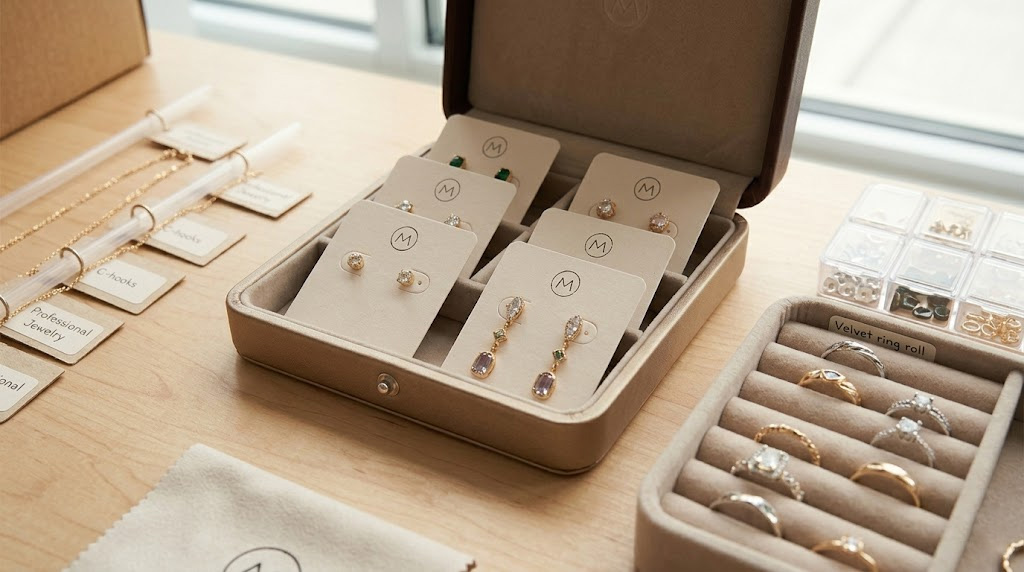
Packing jewelry for a move requires a systematic approach using compartmentalization and specialized materials to prevent tangling, scratching, or loss. Moving inventory is a high-stakes operation where a single error can lead to a messy tangle of gold chains or chipped gemstones. Standard moving boxes fail to protect the intricate fragility of high-value items, often resulting in significant financial loss and hours of detangling. By mastering the professional strategies for how to pack jewelry , you ensure your inventory arrives in showroom condition, ready for immediate sale.
Why is it vital to learn how to pack jewelry for a move?
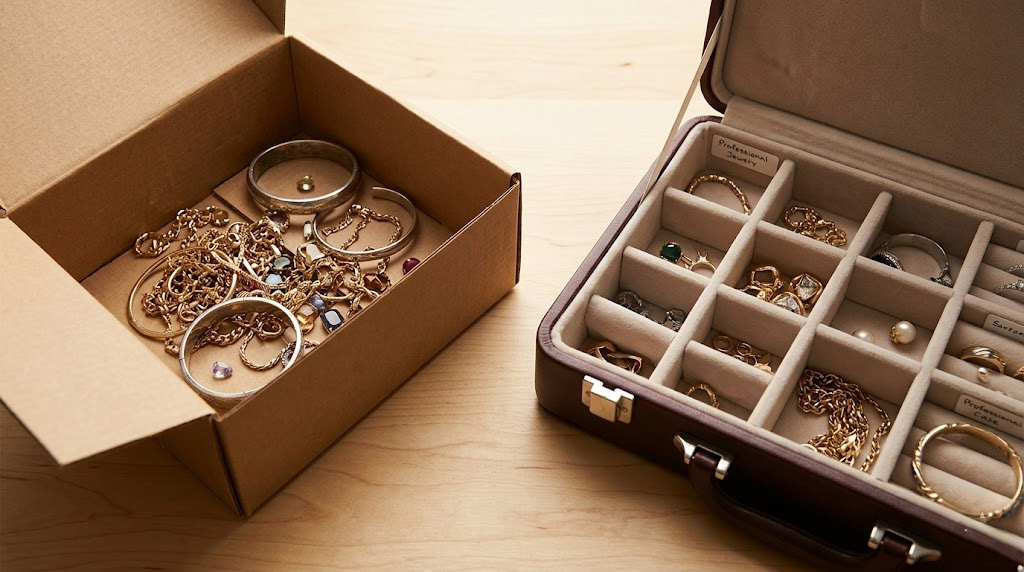
Learning proper packing prevents physical damage and inventory loss that occurs during transit. Retailers must understand how to pack jewelry to avoid the friction that causes scratches and the humidity that invites tarnish. This knowledge protects the value of fine inventory during high-stress transitions like store relocations.
Identifying risks of tangling and inventory damage
Here is the thing:
- Knotting of delicate gold chains.
- Scratching of soft metals by hard stones.
- Gemstone chipping from impact.
- Inventory displacement and loss.
Without individual slots or soft barriers, jewelry pieces interact during movement, leading to micro-abrasions. Preserving the “mint condition” of your collection requires physical isolation for every piece.
Why standard shipping boxes are insufficient
You might be wondering…
- Lack of internal organizational structure.
- Zero shock absorption for vibrations.
- No protection against atmospheric humidity.
- Difficulties with inventory counts.
Standard cardboard boxes allow items to shift and slide, increasing the risk of structural damage. Professional cases provide the necessary grip to keep items stationary regardless of external movement.
Key Takeaways:
- Condition: Specialized packing preserves the retail value of fine metals and stones.
- Organization: Proper containers simplify inventory audits during the unpacking phase.
| Risk Factor | Protective Strategy | Recommended Tool | |
|---|---|---|---|
| Friction | Individual Compartmentalization | Microfiber pouches | |
| Impact | Shock Absorption | Rigid outer cases | |
| Moisture | Humidity Control | Anti-tarnish strips | |
| Loss | Detailed Labeling | Digital inventory logs |
Specialized packing materials serve as the primary defense against the mechanical and environmental stresses of relocation.
How to pack jewelry for pop-ups and trade shows?
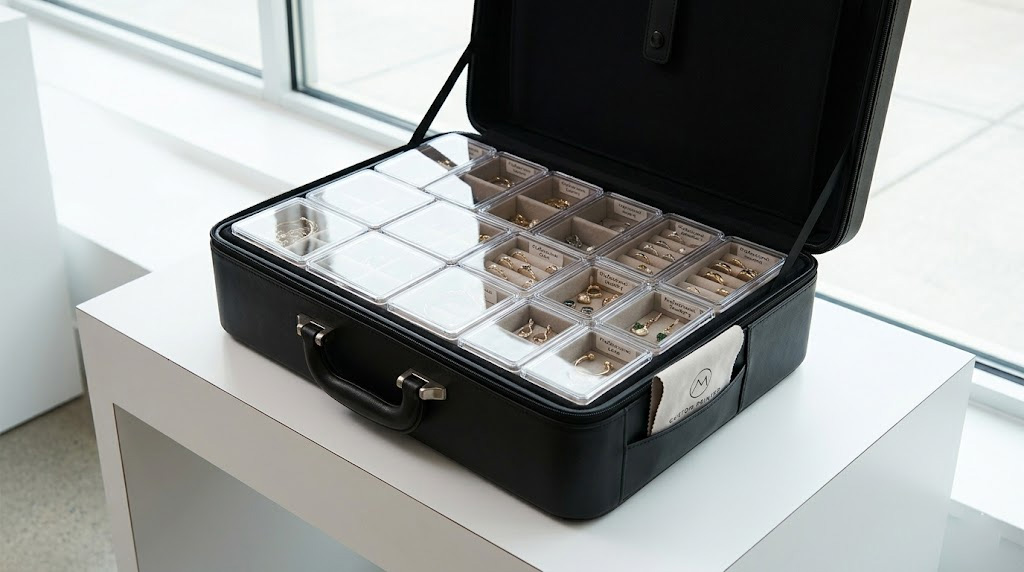
Mobile retail success depends on using stackable, transparent organizers and focusing on high-margin, curated inventory. Professional organizers understand that how to pack jewelry for temporary events requires a balance between protection and speed of setup. Efficiency is the priority when every minute spent unpacking is a minute of lost sales.
Curating a versatile inventory for events
Think about it:
- Focus on bestsellers and high-margin items.
- Pack by themed collection rather than type.
- Prioritize lightweight, durable display pieces.
- Maintain a cohesive brand story in limited space.
A “less is more” approach prevents your display from looking cluttered while reducing the volume of goods to transport. Packing by collection allows for faster visual merchandising upon arrival.
Using stackable trays for efficient setup
It gets better:
- Transparent lids for instant visibility.
- Standardized sizes for secure stacking.
- Foam inserts to keep items stationary.
- Fast-tracking for security inspections.
Stackable trays with clear tops allow you to verify stock levels without opening every container. This system is particularly beneficial during busy trade shows where floor space is limited and speed is essential.
Key Takeaways:
- Mobility: Use lightweight materials to reduce the physical burden of transport.
- Branding: Utilize custom-printed pouches for a premium unboxing experience at the stall.
- Security: High-value items should always stay in a carry-on case.
| Event Goal | Packing Solution | Benefit | |
|---|---|---|---|
| Fast Setup | Stackable Trays | Reduces labor hours | |
| Stock Security | Carry-on Cases | Eliminates theft risk | |
| Brand Impact | Custom Pouches | Enhances customer perception |
The integration of mobility and organization allows a brand to transition from transit to sales in minutes.
How to pack jewelry for necklaces to prevent tangles?
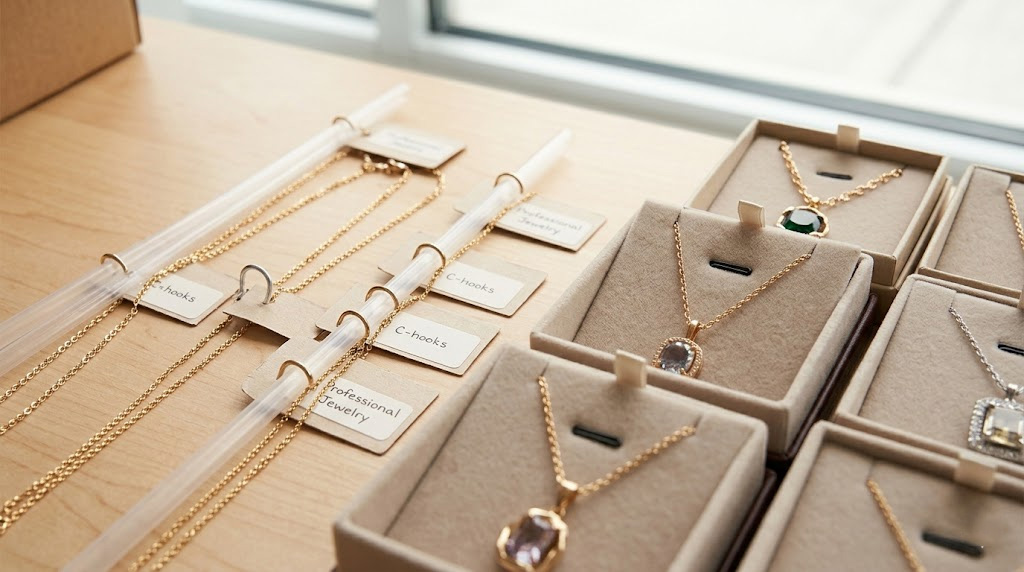
Preventing necklace tangles involves securing the chain via straws, specialized cards, or dedicated necklace boxes . Mastering how to pack jewelry specifically for necklaces means keeping the chain taut at all times. This prevents links from folding onto themselves and forming permanent knots during transit.
The straw and bag method for delicate chains
Consider this:
- Thread one end through a plastic straw.
- Clasp the necklace outside the straw.
- Place the straw in a resealable bag.
- Label by metal type and length.
This simple method ensures that the chain remains straight and cannot double back on itself. It is a cost-effective solution for large inventories of dainty gold or silver necklaces.
Using slotted inserts for high-end pendants
The secret is here:
- Use C-hooks to maintain chain tension.
- High-density foam for stone cushioning.
- Individual compartments for each piece.
- Pressure-fit lids to prevent shifting.
Professional trays use slotted foam to keep the pendant centered and the chain secured behind the insert. Even if the box is inverted, the piece remains in its display position.
Key Takeaways:
- Tension: Keeping chains taut is the only way to guarantee zero knotting.
- Isolation: Pendants must be separated from their chains or secured firmly.
| Method | Best For | Benefit | |
|---|---|---|---|
| Straw Threading | Dainty gold/silver chains | Zero knotting risk | |
| Cardboard Tubes | Chunky statement pieces | Structural support | |
| Slotted Foam | Luxury retail presentation | Display-ready arrival |
Proper tension management eliminates the need for frustrating detangling during your new store opening.
How to pack jewelry like earrings and small rings?
Secure small items by using dedicated earring boxes with cards and velvet ring rolls to isolate each piece. When considering how to pack jewelry with small components, the primary goal is preventing friction between stones. Isolated storage ensures that hard gemstones do not scratch softer metal settings or the luster of pearls.
Utilizing earring cards and ring rolls for security
Here is the reality:
- Keeps pairs together for fast display.
- Prevents stone-on-stone contact damage.
- Absorbs micro-vibrations during shipping.
- Provides a professional presentation immediately.
Earring cards ensure that studs and drops do not get separated or lost in the bottom of a pouch. Velvet ring rolls in a dedicated case provide a non-slip surface that protects the entire circumference of the band.
Compartmentalization tips for tiny components
Look at it this way:
- Use multi-compartment bead organizers.
- Separate earring backs from the front.
- Group jump rings by size and metal.
- Utilize clear labeling on every lid.
Small components like backs and jump rings can be a nightmare to find if spilled. Using rigid, multi-cell containers ensures that every small part remains accessible and accounted for during the setup phase.
Key Takeaways:
- Separation: Each pair or ring deserves its own dedicated slot.
- Material: Use velvet or high-density foam to absorb shocks.
- Visibility: Clear-top organizers save significant time during setup.
| Storage Tool | Best For | Protective Feature | |
|---|---|---|---|
| Ring Rolls | Fine gemstone rings | 360-degree cushioning | |
| Earring Cards | Studs and dangles | Pair retention | |
| Pill Organizers | Spare components | Spill-proof containment |
Strategic isolation of small items prevents the common problem of “missing parts” during a high-pressure move.
How to pack jewelry including luxury watches?
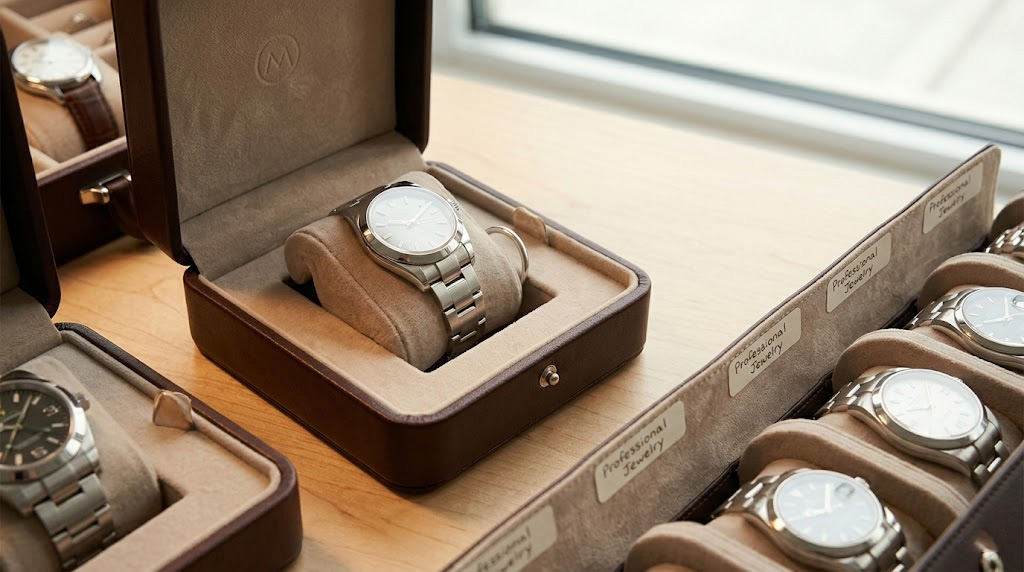
Luxury timepieces require watch boxes with fitted C-rings or pillows to prevent the bracelet from scratching the case back. Understanding how to pack jewelry such as watches is critical because of the high value and fragility of the crystal. Specialized travel rolls offer a compact, secure alternative to bulky original packaging for store moves.
Protecting watch faces with specialized pads
The truth is:
- Prevents crystal scratches from impacts.
- Secures the movement against vibrations.
- Keeps metal bracelets from rubbing the case.
- Maintains bezel alignment during transit.
Using high-density foam pads or soft pillows keeps the watch stationary within its container. This prevents the bracelet from folding inward and scratching the delicate case back or the movement’s exhibition glass.
Original box vs. travel case storage
You see:
- Original boxes offer the best fit.
- Travel rolls save significant storage space.
- Multi-slot cases enhance transport efficiency.
- Shock-resistant outer shells offer maximum safety.
While original boxes are great for branding, they are often too bulky for large-scale store relocations. Multi-slot watch rolls provide the same level of internal protection while occupying a fraction of the cargo space.
Key Takeaways:
- Stationary: The watch must not move inside its container.
- Padding: Soft pillows are essential for maintaining the bracelet shape.
| Protection Level | Packing Material | Use Case | |
|---|---|---|---|
| Level 1: Basic | Microfiber Wrap | Individual retail sales | |
| Level 2: Safe | Watch Roll/Pouch | Trade shows/Pop-ups | |
| Level 3: Maximum | Rigid Watch Box | Long-distance moves |
Choosing between original packaging and travel rolls depends entirely on the volume of inventory and the distance of the move.
How to pack jewelry for a full store relocation?
A full store move requires grouping inventory by display zone and maintaining high-value pieces in personal carry-on luggage. Planning how to pack jewelry for a complete relocation involves detailed inventory audits and temperature-controlled logistics. Organized master cartons help your team set up the new location without searching through unsorted boxes.
Organizing bulk inventory for long-distance transit
Let’s face it:
- Label boxes by specific display zones.
- Use master shipping cartons for consolidation.
- Include printed inventory checklists inside.
- Track every carton with a numbering system.
Grouping items by their future location in the new store—such as “North Wall – Bridal”—dramatically speeds up the unpacking process. This prevents the chaos of having all rings in one box and all necklaces in another, regardless of their collection.
Why you must keep high-value pieces on your person
Above all:
- Minimize the risk of inventory theft.
- Ensure immediate accessibility for VIP clients.
- Bypass potential moving truck delays.
- Maintain compliance with insurance transit riders.
Never send “hero” pieces or custom orders in a standard moving truck. High-value assets should be transported in a locked, discreet travel case that stays with the business owner at all times.
Key Takeaways:
- Audit: Perform a full inventory count before and after.
- Climate: Ensure the vehicle is temperature-controlled to protect glues and metals.
- Insurance: Verify coverage for items while they are “in transit.”
| Move Phase | Key Action | Success Metric | |
|---|---|---|---|
| Pre-Move | Digital Inventory Audit | 100% item accounting | |
| Transit | Personal Carry-on | Zero loss of hero pieces | |
| Arrival | Zone-based Unpacking | Setup completed in <24 hrs |
A systematic approach to bulk relocation transforms a logistical nightmare into a streamlined business transition.
Which supplies help with how to pack jewelry safely?
Essential supplies include anti-tarnish paper, high-density foam inserts, and pH-neutral cotton linings to protect metal finishes. Selecting the right materials for how to pack jewelry prevents chemical reactions like oxidation during long-term transport. Wholesale quality supplies ensure consistency and better stacking efficiency within your logistics chain.
The role of anti-tarnish wraps and cotton lining
Think about this:
- Neutralizes sulfur in the atmosphere.
- Prevents silver and copper oxidation.
- Maintains the “showroom shine” of pieces.
- Provides essential vibration dampening.
Atmospheric moisture is a major threat to silver and copper-based alloys. Anti-tarnish paper or specialized cotton-lined boxes neutralize harmful elements in the air, ensuring jewelry looks polished upon arrival.
Evaluating the benefits of wholesale quality
It turns out:
- Uniform sizing allows for perfect stacking.
- Lower per-unit costs for bulk moves.
- Consistent protection across all product lines.
- Professional brand image throughout the move.
Buying supplies in bulk ensures that every piece of jewelry receives the same high standard of protection. Standardized box sizes also maximize the space inside master cartons, preventing shifting that leads to damage.
Key Takeaways:
- Chemistry: Only use pH-neutral, acid-free materials for fine jewelry.
- Consistency: Uniform packaging simplifies the packing and loading process.
| Supply Item | Primary Function | Business Value | |
|---|---|---|---|
| Foam Inserts | Vibration dampening | Reduces stone loss | |
| Velvet Trays | Organizational layout | Faster visual audit | |
| Custom Boxes | Brand reinforcement | Elevates unboxing |
Investing in professional-grade supplies is a small cost compared to the price of refurbishing damaged inventory.
What common mistakes happen when you how to pack jewelry?
Common errors include overpacking containers, using ink-heavy newspaper, and failing to label boxes clearly. Learning how to pack jewelry involves avoiding non-specialty materials that can cause chemical damage or physical tangles. Small mistakes in material choice can lead to significant refurbishment costs later.
The dangers of overpacking and missing labels
Here is the catch:
- Increased pressure causes structural damage.
- “Mystery box” confusion during setup.
- Slower setup times at the destination.
- Higher risk of item misplacement.
Cramming too much jewelry into a single pouch to save space often results in scratched surfaces and bent prongs. Furthermore, failing to label every side of a master carton leads to hours of wasted time during the move-in day.
Risks of using non-specialty household materials
Consider the following:
- Ink transfer from newspaper to metal.
- Moisture trapping from standard plastic wrap.
- Tape residue damaging luxury boxes.
- Acid damage from non-neutral cardboard.
Never use newspaper, as the ink can cause permanent staining or tarnish on metals. Standard plastic wraps can trap humidity and contain chemicals that react negatively with silver and gold alloys.
Key Takeaways:
- No Ink: Avoid printed papers; use only acid-free tissue.
- No Tape: Never apply adhesive directly to jewelry or luxury cases.
- Weight: Place heavier items at the bottom of master cartons.
| Common Mistake | Potential Damage | Professional Alternative | |
|---|---|---|---|
| Overpacking | Bent prongs / Scratches | Individual compartments | |
| Using Newspaper | Ink tarnish | Acid-free tissue paper | |
| Bulk Pouching | Tangled chains | Necklace cards/boxes |
Avoiding these common pitfalls ensures that your inventory maintains its value and display-ready appearance.
How to pack jewelry to ensure a fast setup?
Achieve a fast setup by implementing “plug-and-play” tray systems and mapping your visual merchandising before packing. When you master how to pack jewelry for speed, you focus on trays that go directly from the box to the display case. This reduces handling and ensures your inventory is polished and ready for customers immediately.
Implementing plug-and-play tray systems
This is important:
- Use non-slip “Ice Grip” tray liners.
- Maintain existing item arrangements.
- Utilize protective tray covers or lids.
- Minimize manual handling of pieces.
The ultimate goal is to lift a tray out of the master carton and place it directly into the showcase. Non-slip liners ensure that even if the tray is tilted during transport, the jewelry stays in its exact designated position.
Mapping your visual merchandising in advance
You might wonder…
- Take reference photos of current displays.
- Pack items in the order of display.
- Label boxes by their physical location.
- Follow a digital floor plan for setup.
Photographing your current displays or creating a digital map for the new location eliminates decision fatigue. By packing items in the order they will be displayed, you streamline the high-pressure environment of move-in day.
Key Takeaways:
- Continuity: Aim for zero reorganization at the destination.
- Protection: Use tray covers to prevent dust and shifting.
| Setup Step | Action Item | Goal | |
|---|---|---|---|
| Unboxing | Follow zone labels | Immediate placement | |
| Cleaning | Final microfiber wipe | Showroom shine | |
| Lighting | Adjust spot lamps | Highlight gem fire |
A fast setup allows your business to resume operations and generate revenue without unnecessary downtime.
Where to find help on how to pack jewelry professionally?
Professional guidance is found by partnering with a specialized manufacturer that offers custom inserts and wholesale scaling. Seeking expert advice on how to pack jewelry allows you to create tailored solutions that fit unique or oversized designs. High-quality manufacturing partners ensure your packaging scales with your business as you open new locations.
Selecting a manufacturer for custom solutions
The bottom line is:
- Tailored foam cutouts for unique shapes.
- Branded presentation for consistent identity.
- Factory-direct pricing to save costs.
- Rapid prototyping for new product launches.
A professional manufacturer can provide tailored inserts that fit your specific jewelry designs perfectly. This level of customization is the best way to protect complex, multi-component pieces that don’t fit into standard stock boxes.
Scaling your packaging for business growth
Keep in mind:
- Volume discount benefits for expansion.
- Reliable and consistent supply chains.
- Repeatable packing systems for staff.
- Unified brand identity across locations.
As your business grows from a single pop-up to multiple retail locations, your packing system must scale accordingly. Investing in factory-direct solutions reduces long-term costs while maintaining the high standards required for luxury goods.
Key Takeaways:
- Customization: Tailor your packaging to your specific product dimensions.
- Efficiency: Factory-direct sourcing eliminates unnecessary middleman costs.
| Service | Benefit | Result | |
|---|---|---|---|
| Custom Design | Tailored to your brand | Unique market identity | |
| Factory Direct | Eliminates middleman | 20% cost savings | |
| Rapid Sampling | 3-5 day prototypes | Faster product launch |
Partnering with the right experts ensures your jewelry remains protected throughout every stage of your business journey.
Successfully relocating your jewelry business requires a blend of high-quality supplies and meticulous organization. By following these professional guidelines, you protect your most valuable assets and ensure a seamless transition to your next location. Our mission is to help brands grow through superior protection and presentation. To secure your inventory with the industry’s best solutions, contact us today to discuss your custom retail packaging needs.
Frequently Asked Questions
Can I use plastic wrap to keep jewelry in trays?It is not recommended because plastic wrap can trap moisture and contains chemicals that may cause metals like silver to tarnish. Use specialized “Ice Grip” covers or anti-tarnish tissue paper instead.
What’s the best way to move high-value custom pieces?High-value items should be packed in individual rigid boxes with high-density foam inserts and transported personally in a discreet, locked travel case.
Can I pack jewelry in checked luggage for a show?No, you should never put jewelry inventory in checked bags. Jewelry should always remain in your carry-on luggage to avoid the risks of theft, loss, or rough handling.
How do I know if my packing materials are anti-tarnish?Professional suppliers will explicitly label their products as acid-free and pH-neutral. Look for materials that specifically mention tarnish-preventative treatments.
What’s the best way to label bulk inventory?Use a color-coded system paired with a master list. Label every tray and master carton with the collection name, item quantity, and its designated display zone in the new store.