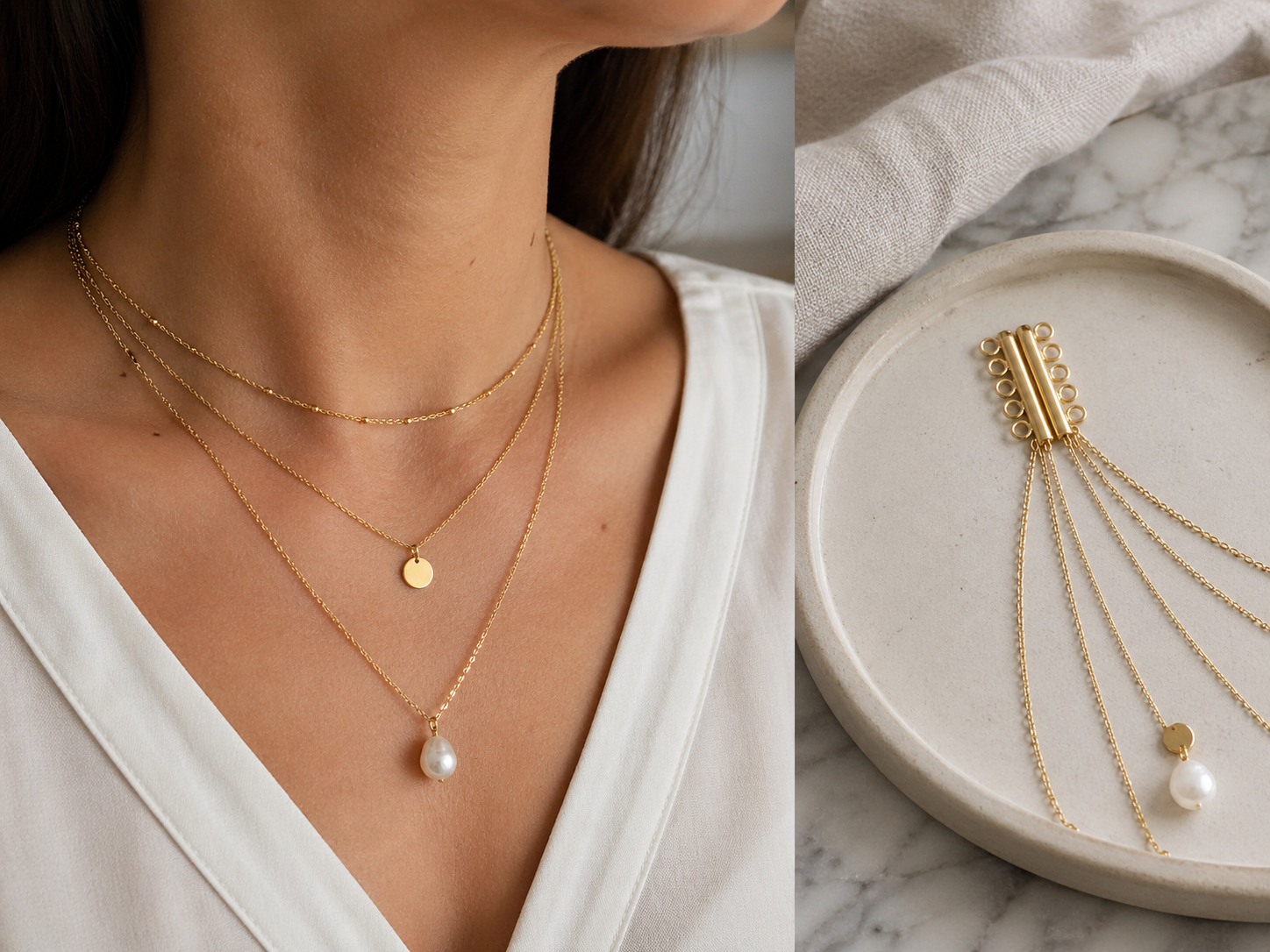
You can master necklace layering by varying your chain lengths, mixing different metal textures, and choosing a strong focal point to anchor the look. Many jewelry lovers struggle with pieces that clump together or become a tangled mess during the day. This frustration often leads to beautiful collections staying hidden in a drawer rather than being shown off in a stylish stack. By learning how to layer jewelry , you can transform individual pieces into a curated fashion statement that enhances your brand or personal aesthetic.
Why is spacing critical when you layer necklaces?

Spacing is vital because it prevents pieces from overlapping and allows each individual design to shine. Understanding how to layer jewelry effectively involves creating a clear visual hierarchy that guides the eye from the neck down to the chest.
How to pick the right lengths?
- Start with a 14-inch choker as your foundation.
- Add an 18-inch mid-length chain for balance.
- Finish with a 22-inch piece to create a vertical line.
Here is the deal: spacing your chains about two inches apart creates a “waterfall” effect. This prevents the necklaces from competing for the same visual space on your neckline.
Should you use a base layer?
- A delicate gold chain works best as a base.
- Avoid using two thick chains at the very top of your stack.
- Select a base that sits comfortably above your collarbone.
Think about it: the base layer sets the tone for the entire ensemble. It provides the starting point that determines where every other piece will fall.
Key Takeaway: Proper spacing is the foundation of a successful layered look, ensuring that every necklace remains visible and distinct.
| Layer Position | Suggested Length | Purpose | |
|---|---|---|---|
| Top Layer | 14″ – 16″ | Frames the face | |
| Middle Layer | 18″ – 20″ | Provides texture | |
| Bottom Layer | 22″ – 24″ | Adds verticality |
Strategic spacing transforms a random pile of gold into a professional fashion statement.
How do varied chain textures enhance your style?

Texture adds dimension by breaking up the uniformity of metal surfaces for a more curated feel. If you are exploring how to layer jewelry, mixing hammered finishes with smooth snake chains is a pro move that creates visual interest.
Can you mix chain styles?
- Combine a bold paperclip chain with a thin cable link.
- Try adding a twisted rope chain for a vintage touch.
- Include a flat herringbone style to reflect more light.
Look: using different weights and patterns stops the necklaces from looking like one giant, inseparable chain. It gives the impression that you have carefully selected each piece for its unique personality.
Why add a hammered finish?
- Hammered metal provides an organic, artisan appearance.
- It reflects light at different angles compared to polished gold.
- This style pairs perfectly with smooth, high-shine pendants.
The best part? Texture makes a monochromatic gold look feel expensive and intentional rather than boring. It creates a rich, multi-layered aesthetic that works for any occasion.
Key Takeaway: Mixing textures like paperclip and herringbone prevents your jewelry stack from appearing flat or overly uniform.
| Texture Type | Visual Effect | Best Placement | |
|---|---|---|---|
| Paperclip | Modern & Bold | Middle Layer | |
| Snake Chain | Sleek & Liquid | Top Layer | |
| Rope Chain | Traditional & Thick | Bottom Layer |
Varying your textures is the fastest way to elevate a simple outfit into a high-fashion look.
Can you layer necklaces without constant tangling?

You can prevent tangling by utilizing multi-strand clasps and necklaces of significantly different weights. Mastering how to layer jewelry requires keeping your chains separated during daily movement to avoid frustrating knots.
Do necklace spacers actually work?
- Spacers hold two or three clasps in a fixed position behind your neck.
- They prevent the necklaces from rotating and shifting forward.
- This tool keeps your “waterfall” spacing consistent all day long.
But wait, there’s more: spacers also protect the delicate metal from rubbing together. This reduces wear and tear on your favorite gold or silver pieces.
Does weight prevent tangling?
- Pair a heavy pendant with a very light top chain.
- The gravity of the heavy piece keeps the stack pulled down.
- Avoid layering three very thin, lightweight chains together.
Why does this matter? Different weights ensure that the chains move at different speeds, which naturally breaks up potential knots. It is a simple physics trick for better jewelry styling.
Key Takeaway: Using mechanical spacers and varying the weight of your pendants are the two most effective ways to stop chains from knotting.
| Solution | Primary Benefit | Ease of Use | |
|---|---|---|---|
| Multi-Clasp Spacer | Stops rotation | High | |
| Weighted Pendant | Keeps layers taut | Medium | |
| Graduated Lengths | Reduces overlap | High |
Keeping your chains separate is essential for maintaining both your style and the lifespan of your jewelry.
What is the best way to choose a focal point?

Choosing a focal point involves selecting one standout pendant to anchor the entire vertical stack. When you decide how to layer jewelry, the bottom-most piece usually serves as the visual centerpiece that ties everything together.
Where should the pendant sit?
- Place your largest pendant on the longest chain in the set.
- Ensure it sits centrally on your chest or below the bust.
- Use a lariat style to draw the eye downward.
Check this out: a strong focal point gives the eye a place to rest. Without it, the layered look can feel chaotic or unfinished to the observer.
Can you use multiple charms?
- Limit yourself to one large charm per layered set.
- Use tiny “station” diamonds on the upper layers for subtle sparkle.
- Keep the other chains simple to avoid a cluttered appearance.
It gets better: a single focal point allows you to tell a story with your jewelry. You can choose a piece that has personal meaning or reflects your brand’s heritage.
Key Takeaway: A singular focal point on the longest chain provides a necessary anchor that balances the lighter layers above.
| Piece Type | Role in Stack | Visual Weight | |
|---|---|---|---|
| Large Medallion | Primary Anchor | Heavy | |
| Small Initial | Subtle Accent | Light | |
| Plain Link | Texture Filler | Medium |
A well-chosen anchor pendant creates a professional and balanced silhouette for any wearer.
How to layer jewelry for a professional office look?

A professional office look requires subtle, high-quality pieces that convey elegance without being distracting. Knowing how to layer jewelry in a corporate setting means favoring minimalist “trios” or “duos” over excessive stacking.
Is less more in the boardroom?
- Stick to two necklaces for a clean, sharp appearance.
- Choose high-shine gold or silver without oversized gems.
- Ensure the lengths fit neatly inside your blouse or blazer.
Listen: professional layering is about refinement, not volume. You want your jewelry to complement your authority, not compete with your presentation.
How to style for a business meeting?
- Use a classic pearl strand paired with a thin gold chain.
- Avoid “noisy” jewelry that jingles when you move or speak.
- Select fixed pendants that won’t slide around during your commute.
Simply put, your goal is a polished look that stays in place. High-quality materials like 14k gold ensure you look prepared and sophisticated.
Key Takeaway: Minimalist layering with two or three high-quality pieces is the standard for professional and corporate environments.
| Office Style | Component 1 | Component 2 | |
|---|---|---|---|
| The Executive | 16″ Snake Chain | 18″ Small Diamond | |
| The Creative | 18″ Paperclip | 20″ Bar Pendant | |
| The Classic | 14″ Gold Choker | 16″ Single Pearl |
Refined layering demonstrates an attention to detail that mirrors your professional work ethic.
Why does the neckline of your shirt matter?
The neckline of your clothing acts as the frame that determines the appropriate length for your necklaces. You must adapt how to layer jewelry so that it complements rather than clashes with your collar or fabric.
What works best for V-necks?
- Choose pendants that follow the angled line of the “V.”
- Layer pieces in a triangular shape to elongate your neck.
- Avoid rounded chokers that cut across the neckline awkwardly.
Check this out: mirroring the shape of your clothing creates a harmonious flow. It makes the jewelry look like it was designed specifically for that outfit.
How to style a turtleneck?
- Opt for longer chains that sit on top of the fabric.
- Use bold textures to ensure the metal isn’t lost in the knit.
- Avoid very thin chains that can easily get snagged on the yarn.
The best part? Layering over a high neck allows you to wear much longer pieces, such as 24-inch or 30-inch chains. This adds a dramatic flair to an otherwise simple winter look.
Key Takeaway: Always match the shape of your jewelry stack to the geometric lines of your shirt’s neckline for the best results.
| Neckline Type | Best Layering Shape | Ideal Lengths | |
|---|---|---|---|
| V-Neck | Graduated V-Shape | 16″, 18″, 22″ | |
| Crew Neck | Rounded/Circular | 14″, 16″, 18″ | |
| Scoop Neck | Wide & Layered | 16″, 20″, 24″ |
Matching your jewelry to your neckline ensures a cohesive and fashionable appearance every time.
Can custom packaging help you style layered sets?
Custom packaging creates a professional “unboxing” experience while demonstrating the perfect spacing for a set. Retailers who teach how to layer jewelry through their presentation often see higher customer satisfaction and brand loyalty.
Why use multi-notch inserts?
- Inserts with multiple slots hold chains at specific intervals.
- This prevents the set from tangling during shipping or storage.
- It shows the customer exactly how the pieces should be worn.
Look: when a customer opens a box and sees a perfectly layered set, they are more likely to buy the entire collection. It removes the guesswork from their styling process.
How does packaging protect your designs?
- Soft velvet linings prevent scratches on polished metal surfaces.
- PE film boxes hold jewelry in place with a vacuum-like seal.
- Secure closures ensure that chains don’t shift and knot together.
Think about it: your packaging is the first interaction a customer has with your layered designs. It should reflect the same level of care and quality as the jewelry itself.
Key Takeaway: High-quality custom inserts protect jewelry from tangling while visually guiding the customer on how to layer their new pieces.
| Packaging Type | Styling Benefit | Protection Level | |
|---|---|---|---|
| Multi-Notch Box | Shows spacing | Very High | |
| PE Film Display | Keeps set fixed | High | |
| Velvet Pouch | Easy for travel | Medium |
Professional packaging is a silent salesperson that reinforces the value of your layered jewelry collections.
How to incorporate pearls into a layered ensemble?
Incorporating pearls adds a classic luster that contrasts beautifully against the hard edges of modern gold chains. Many people wonder how to layer jewelry with organic materials without looking outdated or overly formal.
Can you mix pearls with metal?
- Pair a traditional pearl strand with a heavy gold link chain.
- Use a single pearl drop on a thin cable chain for a modern feel.
- Layer different sizes of pearls for a “shabby-chic” aesthetic.
Here is the deal: the contrast between the soft glow of pearls and the industrial look of metal is a massive trend. It makes pearls feel youthful and accessible for everyday wear.
How to protect pearls in a stack?
- Place the pearl strand as the innermost layer near the skin.
- Avoid letting heavy metal charms rub directly against the pearls.
- Check that your metal chains are smooth to prevent scratching the nacre.
But wait, there’s more: because pearls are organic, they actually benefit from being worn against the skin. Just ensure they are the “top” layer in your vertical spacing.
Key Takeaway: Mixing pearls with gold chains creates a modern contrast that balances traditional elegance with contemporary style.
| Pearl Style | Pairing Suggestion | Vibe | |
|---|---|---|---|
| Baroque Pearl | Chunky Paperclip Chain | Edgy & Modern | |
| Classic Strand | Delicate Gold Wire | Timeless & Elegant | |
| Seed Pearls | Multiple Thin Chains | Boho & Delicate |
Pearls provide a unique texture that metal alone cannot achieve, making your layered look truly stand out.
What role do 3D floating displays play in retail?
3D floating displays allow customers to see the exact spacing and drape of a pre-layered necklace set. These tools make it easy to show customers how to layer jewelry without needing a live model or a standard velvet bust.
Why use PE film for displays?
- The clear film suspends the jewelry as if it were floating in mid-air.
- It allows for a 360-degree view of the entire layered stack.
- The film prevents the necklaces from moving or tangling while on display.
Check this out: floating boxes are compact and stackable, making them perfect for modern retail counters. They highlight the precision of your layering techniques with a clean, high-tech look.
How do they help the customer?
- Customers can see how the different lengths look together instantly.
- It provides a “locked-in” visual of a curated set.
- The display makes the jewelry look like a work of art.
The best part? These displays are also excellent for shipping. They ensure that the beautiful layering you created in the shop arrives perfectly intact at the customer’s home.
Key Takeaway: 3D floating displays are the most effective way to showcase the spacing and detail of layered necklaces in a retail environment.
| Display Feature | Impact on Sales | Tech Aspect | |
|---|---|---|---|
| 360-Degree View | High Engagement | Clear PE Film | |
| Fixed Positioning | Shows Spacing | Tension Seal | |
| Dust Protection | Maintains Shine | Airtight Design |
Utilizing modern display technology helps customers visualize how to wear your products with confidence.
How should you store layered necklaces safely?
Storing layered necklaces safely involves keeping them in separate compartments or specialized PE film boxes. The final step in learning how to layer jewelry is ensuring they don’t knot up when not in use.
Why is vertical storage best?
- Hanging necklaces on hooks prevents the chains from touching.
- Gravity keeps the chains straight and free of small kinks.
- It allows you to see your entire collection at a glance.
Listen: if you store your necklaces in a pile, you will spend twenty minutes untangling them every morning. Vertical storage saves time and protects the delicate links from breaking.
Can PE film boxes help with storage?
- These boxes press the jewelry between two layers of flexible film.
- They stop oxygen from reaching the metal, which prevents tarnishing.
- The necklaces cannot move, so they stay in their layered positions.
Simply put, PE film boxes are the ultimate solution for both travel and long-term storage. They are lightweight, durable, and keep your curated sets ready to wear at a moment’s notice.
Key Takeaway: Proper storage in individual compartments or PE film boxes is the only way to keep your layered sets tangle-free and tarnish-protected.
| Storage Method | Tangle Prevention | Tarnish Protection | |
|---|---|---|---|
| PE Film Box | Excellent | High | |
| Jewelry Tree | Good | Low | |
| Individual Pouches | Moderate | Medium |
Investing in high-quality storage solutions ensures that your layered jewelry remains as beautiful as the day you bought it.
Conclusion
Creating the perfect layered necklace look is an art form that combines personal style with technical precision. By mastering spacing, texture, and focal points, you can build a collection that feels curated and professional. At YiXin Packaging , we believe that beautiful jewelry deserves equally beautiful protection and presentation. Our team is dedicated to providing luxury packaging solutions that help you showcase your brand’s unique style. Please contact us today to learn how we can elevate your jewelry brand with our custom designs and direct factory wholesale pricing!
FAQ
1. How many necklaces should I layer at once?The ideal number is usually three, as this allows for a top, middle, and bottom layer without looking too cluttered or becoming a heavy burden on your neck.
2. What is the best way to stop my necklaces from spinning?Use a necklace spacer or a multi-clasp connector, which keeps each chain fixed in its own slot and prevents the clasps from migrating to the front of your neck.
3. Can I mix gold and silver in the same stack?Absolutely, because mixing metals is a popular modern trend. To make it look intentional, try to include at least one “two-tone” piece that features both gold and silver elements.
4. How do I clean my jewelry when it is layered?You should always clean each piece individually with a soft cloth and appropriate solution, as cleaning them while they are tangled can lead to scratches or missed spots.
5. What should I do if my necklaces get knotted?Use a tiny amount of baby oil and two sewing needles to gently pull the knot apart on a flat surface, taking care not to pull too hard and break the delicate chain links.