
You can tell if jewelry is valuable or costume by examining official hallmarks, performing physical tests like the magnet or vinegar methods, and observing how the material reacts to your skin. Many people struggle when inheriting a collection or finding a unique piece at a flea market because they lack the technical knowledge to distinguish precious metals from clever imitations. This uncertainty can lead to missed financial opportunities or the frustration of accidentally damaging a piece you thought was fake. Learning how to tell if jewelry is real empowers you to sort through any collection with the precision of a professional collector.
What markings show how to tell if jewelry is real?

Hallmarks and metal stamps are the primary indicators of a piece’s material purity and value. Knowing how to tell if jewelry is real requires looking for small numbers etched into the metal surfaces. These stamps are often hidden on the inside of ring bands or near the clasps of necklaces.
Look:
- 10k, 14k, or 18k for gold content.
- 925 or “Sterling” for silver pieces.
- PLAT or 950 for platinum items.
- GF or HGP for plated costume jewelry.
Where are stamps usually located?
You will typically find these markings in discreet areas where they won’t interfere with the jewelry’s aesthetic. Check the posts of earrings, the inner circumference of bracelets, and the tiny links near a chain’s closure. If a piece lacks any markings at all, there is a high probability it is costume jewelry.
Key Takeaway: Official hallmarks act as a certificate of authenticity stamped directly onto the metal, separating fine jewelry from fashion pieces.
| Metal Type | Standard Hallmark | Meaning | |
|---|---|---|---|
| Gold | 14k / 585 | 58.5% Pure Gold | |
| Silver | 925 | 92.5% Pure Silver | |
| Platinum | PLAT | Pure Platinum |
The presence of a hallmark is the fastest way to verify a piece’s high-value metal composition.
Can magnets help you learn how to tell if jewelry is real?

A strong magnet helps identify base metals because pure gold and silver are not naturally magnetic. Understanding the magnetic properties of metals is a vital step in how to tell if jewelry is real without needing expensive chemicals. If your item jumps toward the magnet, it contains iron, nickel, or steel.
Here is the kicker:
- Gold does not attract magnets.
- Silver remains completely inert.
- Platinum shows no magnetic pull.
- Steel and iron stick instantly.
Why do some real chains stick?
You might notice that the clasp of a real gold chain sticks to a magnet even if the links do not. This is because the internal spring inside the clasp is often made of steel for durability. Focus your testing on the main body of the jewelry rather than the functional hardware.
Key Takeaway: Magnetic attraction is a “red flag” that almost always confirms the presence of cheap base metals used in costume jewelry.
| Material | Magnetic? | Jewelry Category | |
|---|---|---|---|
| Solid Gold | No | Fine Jewelry | |
| Sterling Silver | No | Fine Jewelry | |
| Stainless Steel | Yes | Costume Jewelry |
A simple magnet test can immediately filter out most low-value imitations from your collection.
How does skin color show how to tell if jewelry is real?

Real precious metals like high-karat gold and platinum do not react with your skin or turn it green. Learning how to tell if jewelry is real through the skin test is highly effective for pieces you wear frequently. If a ring leaves a dark or colorful stain, it is likely composed of copper or brass.
But wait, there is more:
- Green stains indicate copper content.
- Black marks suggest silver oxidation.
- Rashes can signal nickel allergies.
- No reaction usually means gold.
Why do fakes react with sweat?
Costume jewelry often uses base metals that oxidize when they come into contact with the acids in your perspiration. This chemical reaction creates a byproduct that stains the skin and eventually causes the plating on the jewelry to flake off. Authentic gold is chemically stable and will never cause these unsightly marks.
Key Takeaway: The absence of skin discoloration after long-term wear is a strong indicator of high-purity gold or platinum.
| Metal | Skin Reaction | Likely Value | |
|---|---|---|---|
| 18k Gold | None | High | |
| Copper/Brass | Green | Low | |
| Nickel | Itchiness/Redness | Low |
Watching how your body interacts with the metal provides a long-term diagnostic of its purity.
Does the breath test show how to tell if jewelry is real?

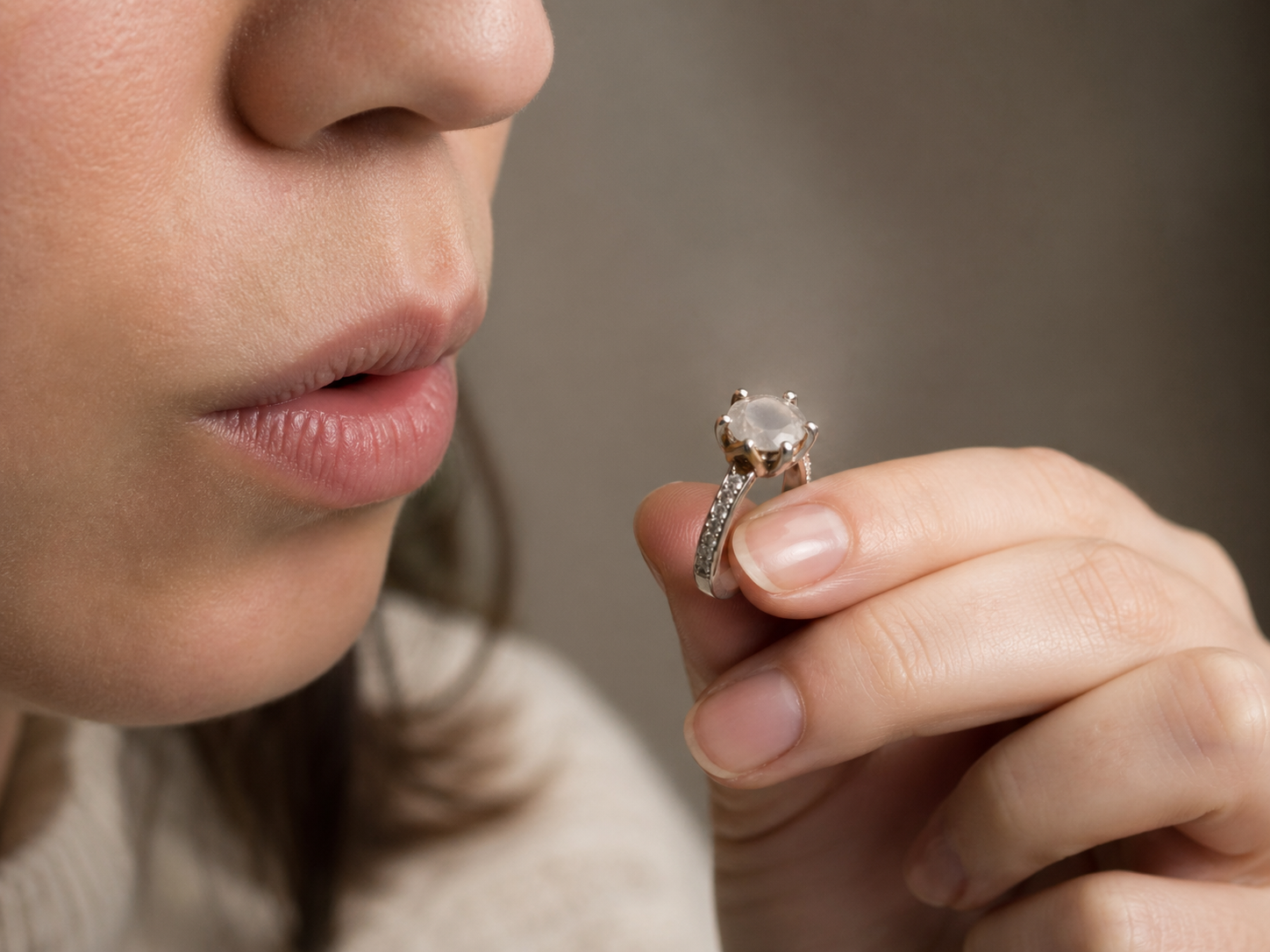
The breath test is a quick way to identify real diamonds because they disperse heat almost instantly. This is a crucial technique for how to tell if jewelry is real when examining stones that appear to be diamonds. Simply fog the stone with your breath as if you were cleaning a pair of glasses.
Think about this:
- Diamonds clear instantly.
- Glass stays fogged up.
- Cubic Zirconia holds fog.
- Moissanite disperses heat fast.
Why do diamonds stay clear?
Diamonds are among the most efficient heat conductors on Earth, meaning they do not allow condensation to settle on their surface for long. If the stone remains foggy for several seconds, it is likely a synthetic material like glass or plastic. This test is highly reliable for a quick field evaluation of gemstones.
Key Takeaway: Thermal conductivity is a physical property of diamonds that most costume jewelry stones cannot replicate.
| Stone | Fog Duration | Authenticity | |
|---|---|---|---|
| Real Diamond | < 1 Second | Authentic | |
| Cubic Zirconia | 3-5 Seconds | Costume | |
| Glass | 5+ Seconds | Costume |
Using your own breath allows you to verify diamond authenticity in seconds without special tools.
Can vinegar determine how to tell if jewelry is real?

Pure gold will not change color or degrade when exposed to a few drops of common white vinegar. When exploring how to tell if jewelry is real , the vinegar test acts as a simple acid check you can perform in your kitchen. If the metal turns dark or begins to sizzle, it is definitely not pure gold.
Listen:
- Use a small dropper.
- Apply to a hidden spot.
- Watch for color shifts.
- Wipe clean immediately.
What happens to plated items?
If a piece is merely gold-plated, the vinegar may eat through the thin surface layer and react with the base metal underneath. Solid gold remains completely unaffected by the mild acidity of the vinegar, maintaining its original luster. Always perform this test on a small, inconspicuous area to avoid visible damage to costume pieces.
Key Takeaway: Gold’s resistance to acid is a defining characteristic that separates it from common decorative alloys.
| Reaction | Metal Type | Status | |
|---|---|---|---|
| No Change | Solid Gold | Valuable | |
| Turns Black | Base Metal | Costume | |
| Sizzles | Zinc/Aluminum | Costume |
Acid resistance testing provides a chemical confirmation of gold purity that visual inspection might miss.
Do green specks explain how to tell if jewelry is real?
Green specks indicate the corrosion of base metals like copper or brass, proving the piece is costume jewelry. Knowing how to tell if jewelry is real involves looking for “verdigris,” which is the green crust that forms on oxidized non-precious metals. Solid gold and platinum do not corrode or develop these green spots.
Believe it or not:
- Verdigris is a rot.
- Gold never turns green.
- Brass reacts with moisture.
- Copper turns green easily.
Can verdigris be removed?
While you can clean the green oxidation off costume jewelry, it will eventually return because the base metal is reacting with the air. If you see green spots on a “gold” necklace, the gold is likely just a thin plating that has worn away. Valuable fine jewelry remains pristine and free of corrosion for decades.
Key Takeaway: Corrosion and green oxidation are definitive signs that a piece is made of low-value base metals.
| Appearance | Material | Valuation | |
|---|---|---|---|
| Green Crust | Copper/Brass | Very Low | |
| Shiny/Clean | Solid Gold | High | |
| Dark Tarnish | Sterling Silver | Moderate |
The presence of green oxidation is an immediate “fail” for any item claimed to be solid gold.
Does weight reveal how to tell if jewelry is real?
Genuine gold and platinum are significantly denser and heavier than the lead or tin alloys used in costume jewelry. When you are learning how to tell if jewelry is real , the “heft” of a piece in your hand provides an immediate clue. A solid gold ring will feel surprisingly substantial compared to a plastic or hollow metal version.
Check this out:
- Gold is very dense.
- Platinum is even heavier.
- Lead feels soft/heavy.
- Plastic feels like nothing.
Why does density matter?
Precious metals have a high atomic weight, meaning a small amount of material weighs much more than a similar volume of steel or aluminum. If a large, chunky chain feels light and “tinny,” it is almost certainly a costume piece. Experienced collectors often use the weight of a piece as their first screening tool.
Key Takeaway: The physical weight and density of a piece are difficult for counterfeiters to replicate without using expensive materials.
| Feel in Hand | Potential Material | Likely Category | |
|---|---|---|---|
| Surprising Heft | Gold/Platinum | Fine Jewelry | |
| Lightweight | Plastic/Aluminum | Costume | |
| Medium Weight | Silver/Steel | Varies |
Evaluating the density of your jewelry can help you spot fakes that look heavy but feel light.
Can ceramic plates show how to tell if jewelry is real?
Dragging a piece across an unglazed ceramic plate reveals its true nature through the color of the streak it leaves behind. This is a classic method for how to tell if jewelry is real when you suspect an item is only gold-plated. A gold streak indicates genuine gold, while a black streak indicates a fake.
The truth is:
- Gold leaves gold marks.
- Pyrite leaves black marks.
- Plating leaves dark lines.
- Ceramic must be unglazed.
Will this test scratch my jewelry?
Yes, the ceramic test is abrasive and can leave a small scratch on the surface of the item being tested. Because of this, you should only use this method on a small, hidden area like the inside of a ring shank. If the streak is black or grey, you have confirmed the item is a base metal imitation.
Key Takeaway: The internal color of a metal revealed through a ceramic streak is a definitive proof of its composition.
| Streak Color | Metal Result | Authenticity | |
|---|---|---|---|
| Yellow/Gold | Real Gold | Genuine | |
| Black/Grey | Base Metal | Fake | |
| No Streak | Too Hard (Stone) | N/A |
The ceramic streak test is a foolproof way to see past the surface plating of any jewelry item.
Do jump rings demonstrate how to tell if jewelry is real?
Fine jewelry features soldered jump rings that are completely closed, while costume jewelry often has open loops. When analyzing how to tell if jewelry is real , you must look at the quality of the construction and the connections. High-end jewelers take the time to weld every link shut to ensure the piece never falls apart.
Keep this in mind:
- Soldered rings are solid.
- Open rings are cheap.
- Seamless joints show quality.
- Rough edges indicate fakes.
What does the clasp say?
Beyond the jump rings, check the overall quality of the clasp mechanism to see if it is sturdy and well-finished. Costume jewelry typically uses flimsy “lobster” claws or spring rings that feel light and break easily under pressure. Fine jewelry uses heavy-duty, hallmarked hardware that matches the metal of the rest of the piece.
Key Takeaway: Professional-grade construction and soldered connections are hallmarks of valuable, long-lasting fine jewelry.
| Construction Detail | Fine Jewelry | Costume Jewelry | |
|---|---|---|---|
| Jump Rings | Soldered/Closed | Open/Bent | |
| Solder Points | Invisible | Visible/Discolored | |
| Overall Finish | Smooth/Polished | Rough/Pitted |
Examining the fine details of construction reveals whether a piece was mass-produced or handcrafted by a master.
Is an appraisal the best way how to tell if jewelry is real?
A professional appraisal is the only 100% accurate method to determine the material purity and market value of your jewelry. While home tests are great for screening, knowing how to tell if jewelry is real for insurance or sale purposes requires an expert’s eye. Appraisers use specialized electronic testers and X-ray technology to verify every component.
Here is the bottom line:
- Experts use acid kits.
- Electronic testers check gems.
- XRF guns scan metals.
- Certificates provide proof.
When should you see a jeweler?
You should seek a professional opinion if you find a piece that lacks hallmarks but passes all your home physical tests. Antique jewelry or custom-made pieces often lack stamps but can be worth thousands of dollars due to their material content. A certified appraiser will provide a written document that protects your investment.
Key Takeaway: Professional testing eliminates all doubt and provides the legal documentation needed for high-value jewelry collections.
| Evaluation Method | Accuracy Level | Best Use Case | |
|---|---|---|---|
| Home Testing | 75% | Initial Sorting | |
| Jeweler’s Loupe | 90% | Checking Marks | |
| Professional Appraisal | 100% | Insurance/Selling |
A professional evaluation is the final and most important step in establishing the true worth of your collection.
Frequently Asked Questions
Can I use a lighter to see if my jewelry is real?No, using a lighter is not recommended because soot can build up on the piece and mislead you. While real gold doesn’t melt at low temperatures, a flame can permanently damage the stones or the finish of costume jewelry.
What’s the best way to clean jewelry before testing it?The best way is to use warm water and a few drops of mild dish soap with a soft toothbrush. Removing surface oils and dirt makes it much easier to see tiny hallmarks and the true color of the metal.
How do I know if a pearl is real or plastic?Run the pearl gently along the edge of your front teeth to feel for a gritty, sandpaper-like texture. Real pearls are made of layers of nacre and feel slightly rough, while plastic or glass fakes feel perfectly smooth.
Can a piece be real gold if it has no stamp?Yes, it is possible if the item is very old and the stamp has worn away, or if it was a custom-designed piece. In these cases, you should have a jeweler perform an acid or electronic test to be certain.
How do I know if my silver is real or just silver-plated?Check for the “925” stamp and perform a magnet test; silver-plated items often have a magnetic base metal underneath. You can also rub the piece with a white polishing cloth; real silver will leave a black mark on the cloth due to oxidation.
To ensure your valuable collection remains organized and protected from environmental damage, please feel free to contact us at our homepage .