Custom jewelry is a uniquely designed and handcrafted piece of fine jewelry created specifically to meet an individual client’s vision and requirements, rather than being mass-produced in a factory. You likely encounter the same frustration many boutique owners face: a showroom filled with generic pieces that fail to excite your high-end clientele. This lack of distinction can make your brand feel interchangeable with any big-box retailer, diluting your market authority.
The pain of mass production is that it often lacks the soul and narrative that modern luxury consumers crave, leaving you with stagnant inventory and dwindling margins. Transitioning your business model to include what is custom jewelry provides the ultimate solution by offering bespoke excellence that guarantees exclusivity and builds lifelong brand loyalty.
What is custom jewelry and how does it differ?

Custom jewelry is characterized by its one-of-a-kind nature, where every design element is dictated by the client’s specific aesthetic and functional needs. Understanding the fundamentals of what is custom jewelry is the first step toward differentiating your brand from competitors who rely solely on off-the-shelf inventory.
Defining One-of-a-Kind Pieces
Look: A one-of-a-kind piece is more than just an accessory; it is a collaborative work of art. These items are never replicated, ensuring that your customer owns something truly unique in the world.
- Hand-selected gemstones and metals.
- Specific dimensions tailored to the wearer.
- Unique design motifs that tell a personal story.
- Limited edition or single-run production.
Moving Beyond Mass Production
But wait, there is more. Mass production focuses on volume and cost-cutting, which often results in thinner metal bands and lower-grade stones. By choosing custom routes, you prioritize structural integrity and artistic merit over assembly-line speed.
- Superior durability compared to cast-molded replicas.
- Attention to minute details in the setting and prongs.
- Higher resale and sentimental value over time.
- Ethical sourcing transparency for every component.
Key Takeaway: Custom jewelry offers a level of artisan quality and structural density that mass-produced items simply cannot match, providing your brand with a significant luxury edge.
| Feature | Custom Jewelry | Mass-Produced Jewelry | |
|---|---|---|---|
| Exclusivity | 100% Unique | Thousands of identical units | |
| Durability | High-density construction | Lightweight/fragile | |
| Client Input | Full Creative Control | Zero Input |
This comparison highlights why luxury retailers are shifting toward bespoke models to secure higher-tier market segments.
How do you plan what is custom jewelry designs?

Planning custom jewelry designs involves a structured consultation process where a client’s abstract ideas are translated into technical blueprints. Master the intake process for what is custom jewelry to ensure that the final physical product perfectly aligns with the initial conceptual vision.
Sharing Your Initial Vision
Think about this: Every great masterpiece starts with a simple conversation or a rough sketch. You should encourage your clients to bring inspiration photos or heirlooms that they wish to modernize.
- Mood boards and Pinterest collections.
- Physical sketches or digital mockups.
- Notes on preferred metal colors and textures.
- Budgetary constraints and milestone deadlines.
Working with Professional Designers
Here is the kicker. Professional designers use their technical expertise to ensure that your client’s “dream” is actually wearable and safe for the gemstones. They balance the aesthetic desires with the physics of jewelry making to create a lasting piece.
- Advice on stone security and prong styles.
- Guidance on metal compatibility and allergies.
- Integration of ergonomics for daily wear.
- Expertise in proportions and visual balance.
Key Takeaway: A successful planning phase acts as the foundation for the entire project, reducing the risk of costly revisions and ensuring total client satisfaction.
| Planning Stage | Action Item | Goal | |
|---|---|---|---|
| Discovery | Concept Discussion | Define Style & Purpose | |
| Drafting | Technical Sketching | Verify Feasibility | |
| Agreement | Final Blueprint Approval | Lock in Specs & Budget |
Effective design planning transforms vague ideas into actionable manufacturing steps that save time and resources.
What is custom jewelry creation from sketch to wax?

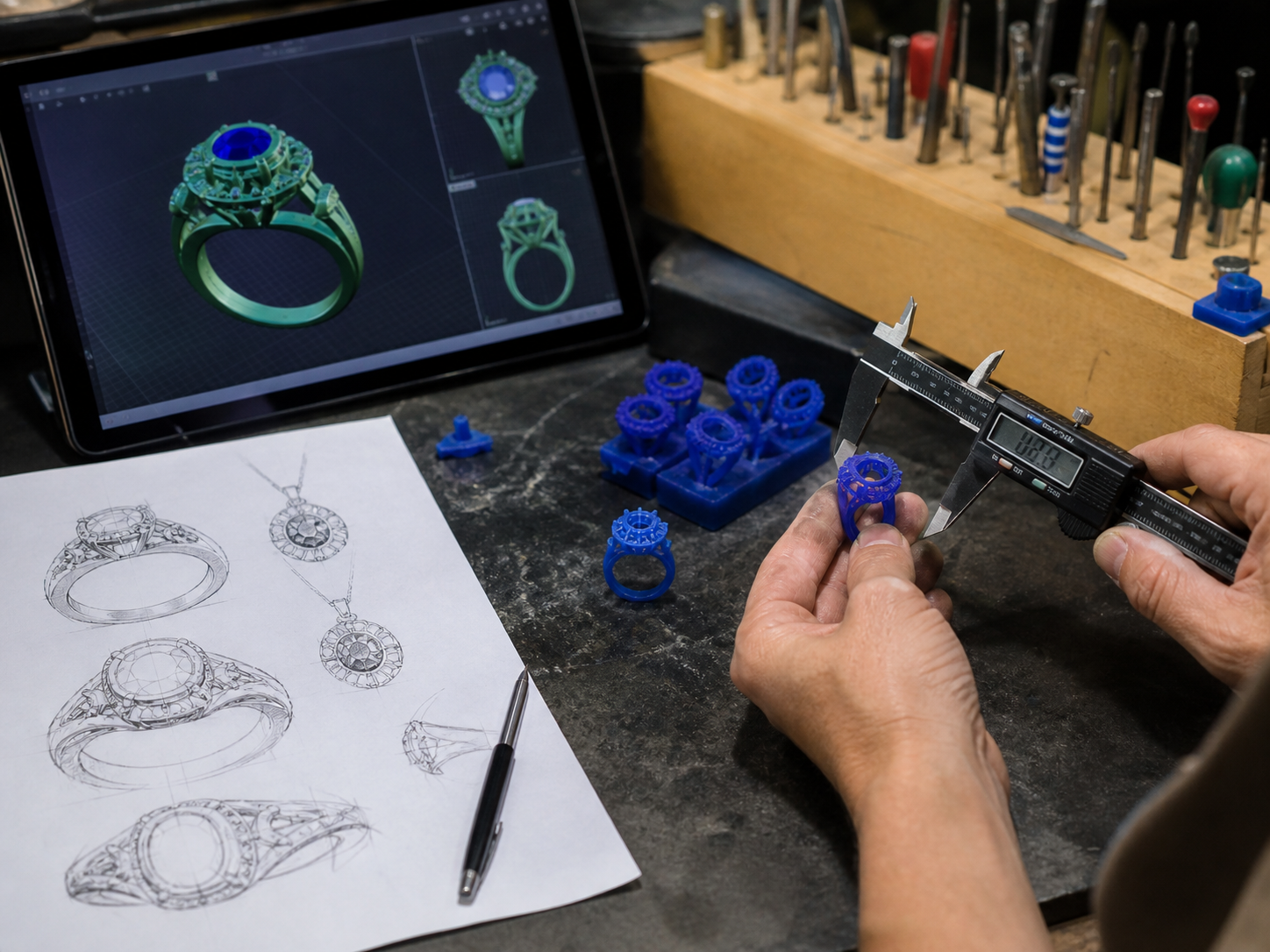
The transition from a two-dimensional sketch to a three-dimensional wax model is where the physical journey of a custom piece begins. Navigating the nuances of what is custom jewelry at this stage allows the client to touch and feel a prototype before the expensive metal is poured.
Creating the 3D Wax Model
Here is the thing: Modern jewelry labs use high-resolution 3D printers or CNC machines to carve intricate wax models from digital files. This ensures that every curve and setting is rendered with mathematical precision.
- Extreme accuracy in stone seat placement.
- Ability to print multiple versions for comparison.
- Rapid prototyping of complex geometric shapes.
- Physical representation of the final scale.
Visualizing Your Design Early
But that’s not all. Seeing the wax model allows the client to request adjustments to the height or thickness of the piece without wasting precious metals. It is the ultimate “safety net” in the bespoke production workflow.
- Trial fitting for ring sizes and comfort.
- Checking the visual weight of the design.
- Validating the placement of side stones.
- Confirming the overall aesthetic harmony.
Key Takeaway: Utilizing wax models provides a tangible prototype that eliminates guesswork, ensuring the final gold or platinum piece is exactly what the client expected.
| Step | Method | Purpose | |
|---|---|---|---|
| CAD Design | Computer Modeling | Precision Engineering | |
| Wax Printing | 3D Rapid Prototyping | Physical Verification | |
| Final Check | Client Hand-on | Design Approval |
This phase is critical for maintaining high B2B standards, as it prevents the production of flawed or unsatisfactory final inventory.
What is custom jewelry casting and metal selection?

Casting is the transformative process where a wax model is replaced by molten precious metal through the “lost wax” technique. Selecting the right materials for what is custom jewelry is vital for the longevity and prestige of the brand you are building.
Choosing Gold or Sterling Silver
But that’s not all. The choice between 14k gold, 18k gold, or platinum significantly impacts the durability and color profile of the finished item. You must guide your clients toward metals that suit their lifestyle, whether it is for an everyday wedding band or a special occasion pendant.
- 14k Gold: High durability for daily use.
- 18k Gold: Richer color and higher gold content.
- Platinum: Naturally white and hypo-allergenic.
- Sterling Silver: Ideal for larger, fashion-forward custom pieces.
The Precision Casting Process
The best part? Casting involves placing the wax model into a flask, filling it with investment material, and then burning out the wax to leave a perfect hollow mold. Molten metal is then centrifugal or vacuum cast into this void.
- Controlled atmosphere to prevent porosity.
- Exact temperature regulation for metal flow.
- Preservation of ultra-fine surface details.
- Uniform density for structural strength.
Key Takeaway: High-quality casting ensures that the piece is structurally sound and free of internal voids, which is essential for a luxury product that must stand the test of time.
| Metal Type | Benefit | Best Use Case | |
|---|---|---|---|
| Platinum | Incredible Strength | Engagement Rings | |
| 18k Gold | Luxury Feel & Color | Fine Fashion Pieces | |
| 14k Gold | Scratch Resistance | Active Wearers |
Understanding metal properties allows you to provide better advisory services to your clients, further cementing your role as an expert.
What is custom jewelry gem setting and finishing?

Gem setting is the delicate art of securing stones into the metal, while finishing provides the final high-luster polish that defines fine jewelry. The final stages of what is custom jewelry are where the true craftsmanship of the master jeweler is most visible to the naked eye.
Selecting Your Perfect Diamonds
Look: For custom orders, you can source stones that fit exact color, clarity, and cut parameters rather than being forced to use whatever is already set in a tray. This allows for a level of matching and precision that is impossible in bulk retail.
- GIA or IGI certified center stones.
- Precision-cut melee for uniform sparkle.
- Ethically sourced and conflict-free options.
- Fancy color diamonds or rare colored gemstones.
Adding the Final Polished Touches
But wait, there is more. Polishing involves multiple stages of abrasive wheels and buffs to remove any casting marks and bring out the mirror-like shine of the metal. This is also when texture effects like matte or brushed finishes are applied.
- High-polish, mirror-like surfaces.
- Sophisticated satin or sandblasted textures.
- Hand-engraved details for added character.
- Final ultrasonic and steam cleaning.
Key Takeaway: The precision of the gem setting and the quality of the final polish are the hallmarks of a professional custom studio, directly influencing the perceived value of the piece.
| Finish Type | Visual Effect | Maintenance Level | |
|---|---|---|---|
| High Polish | Brilliant Shine | High (shows scratches) | |
| Brushed | Soft, Modern Look | Low (hides wear) | |
| Hammered | Artisan, Textured | Medium |
A meticulous finishing process ensures that the piece arrives in its jewelry box as a flawless, “red-carpet ready” asset for your client.
What is custom jewelry for rings and bracelets?
Custom applications for rings and bracelets allow for total ergonomic and aesthetic customization that off-the-shelf items cannot provide. When discussing what is custom jewelry for these categories, focus on the unique ability to contour the jewelry to the individual wearer’s body.
Personalized Engagement Rings
It gets better. An engagement ring is often the most significant jewelry purchase a person will make, and custom design allows it to be completely unique to the couple’s story. From hidden halos to custom-tapered shanks, every detail is intentional.
- Unique stone orientations (e.g., east-west).
- Integration of meaningful birthstones.
- Custom heights for wedding band stacking.
- Intricate filigree and vintage milgrain.
Unique Bracelets and Watches
Here is the thing: Bracelets require specific engineering to ensure they are flexible enough for movement but strong enough for security. Customizing links or watch faces provides a level of personalization that defines high-end masculine and feminine fashion.
- Custom link widths and weights.
- Personalized engraving on clasps or backplates.
- Specific lengths for the perfect wrist drape.
- Inlay work with rare woods or stones.
Key Takeaway: Bespoke rings and bracelets solve common fit and style issues, providing a level of comfort and “wow factor” that drives high customer satisfaction ratings.
| Jewelry Type | Customization Opportunity | Primary Benefit | |
|---|---|---|---|
| Ring | Shank Shape & Setting | Perfect Fit & Style | |
| Bracelet | Link Weight & Clasp | Durability & Comfort | |
| Watch | Dial & Material Mods | Unmatched Exclusivity |
Offering these customized categories allows you to capture a larger share of the bridal and luxury gifting markets.
How long does what is custom jewelry take to make?
The production timeline for a bespoke piece is longer than purchasing stock inventory, typically ranging from three to eight weeks. Managing expectations regarding what is custom jewelry timelines is essential for maintaining a professional B2B reputation and avoiding client disappointment.
Understanding the Production Timeline
You might be wondering: Why does it take weeks to finish a single ring when a store has hundreds ready to go? The answer lies in the sequential nature of handcrafted production and the necessary stages of client approval.
- Design phase: 1–2 weeks.
- CAD/Wax production: 1 week.
- Casting and cleanup: 1 week.
- Setting and polishing: 1–2 weeks.
Factors That Influence Wait Times
But that’s not all. Sourcing a specific, rare gemstone can add significant time to the project if the stone is not currently in your vault. Seasonal demand, such as the period before the winter holidays or Valentine’s Day, can also impact factory schedules.
- Complexity of the metalwork.
- Number of stones to be set.
- Availability of specialized artisans.
- Client response time for approvals.
Key Takeaway: Clear communication about lead times ensures a smooth experience, allowing you to build trust by delivering high-quality work within the agreed-upon window.
| Project Stage | Typical Duration | Potential Delay Factor | |
|---|---|---|---|
| Concept | 3-7 Days | Client indecision | |
| Manufacturing | 14-21 Days | Sourcing rare materials | |
| Quality Check | 2-3 Days | Minor technical tweaks |
Proactive timeline management is a hallmark of premium service and prevents the stress of last-minute rushes.
Why is what is custom jewelry so exclusive today?
Exclusivity in the modern market is driven by the desire for self-expression and the rejection of fast-fashion trends. Incorporating what is custom jewelry into your brand strategy taps into a psychological need for “status through distinction” among affluent buyers.
Expressing Your Personal Style
In fact: Custom jewelry serves as a visual signature that allows your clients to stand out in a world of algorithmic trends. It gives them the agency to be the creative director of their own luxury collection.
- Avoidance of “same-day” fashion overlaps.
- Creative freedom without retail limitations.
- Ability to mix metals and eras.
- Personalized storytelling through design.
Owning Pieces Nobody Else Has
Wait, there’s more. True luxury is about having access to things that cannot be bought off a shelf by anyone else. This “barrier to entry” created by the custom process increases the social currency of the pieces you create.
- Guaranteed uniqueness in social settings.
- Protection against “knock-off” designs.
- Enhanced prestige of the brand’s bespoke arm.
- Limited production runs of signature styles.
Key Takeaway: Exclusivity is the primary driver of luxury margins, making custom jewelry an essential offering for any brand looking to scale into high-end markets.
| Driver of Exclusivity | Custom Jewelry | Luxury Brand Retail | |
|---|---|---|---|
| Availability | One unit only | Global store availability | |
| Customization | Infinite | Limited to color/size | |
| Uniqueness | Absolute | Relative to brand tier |
Focusing on exclusivity allows you to command premium pricing while providing unparalleled value to your customers.
Is what is custom jewelry a cost-effective choice?
Contrary to popular belief, custom jewelry can be more cost-effective because you pay for quality and materials rather than massive retail markups and brand name premiums. Educating your clients on the value of what is custom jewelry helps them see it as a smart long-term investment.
Comparing Prices to Retail Items
Wait, there is more. In many cases, a custom jeweler can recreate a look inspired by a famous brand for a fraction of the cost by sourcing the materials directly and eliminating international marketing overhead. You are paying for the artisan’s time, not a television ad campaign.
- Direct sourcing of diamonds and gems.
- Lower overhead than massive flagship stores.
- Transparent pricing on metal weights.
- Labor costs tied directly to the piece.
Value of Long-Term Craftsmanship
Consider this: A custom piece is built to last for generations, whereas mass-produced items often require frequent repairs or component replacements. When you calculate the “cost per wear” over a lifetime, custom jewelry often comes out on top.
- Thicker bands that resist bending.
- Higher-quality prongs that protect stones.
- Easy to repair and maintain due to solid build.
- Retains higher intrinsic material value.
Key Takeaway: Custom jewelry offers a better price-to-quality ratio, allowing clients to get more “jewelry” for their dollar while ensuring a more durable final product.
| Cost Component | Custom Jewelry | High-End Retail | |
|---|---|---|---|
| Material Cost | Primary Focus | Secondary to Brand | |
| Marketing Markup | Minimal | 300% – 1000% | |
| Repair Liability | Low (Strong Build) | High (Thin Build) |
Presenting these facts helps shift the conversation from “how much it costs” to “how much value it provides.”
What is custom jewelry and its emotional impact?
The emotional connection to a custom piece is far deeper than a stock item because it often represents a major life milestone or a family legacy. Using what is custom jewelry to mark these moments transforms your product into a cherished heirloom.
Creating Meaningful Family Heirlooms
Consider this: A custom piece can incorporate diamonds from a grandmother’s ring or gold from a father’s wedding band, literally weaving family history into a new design. This creates an object of immense sentimental value that transcends its material cost.
- Recycling antique stones into modern settings.
- Engraving secret messages inside the band.
- Passing down unique stories with the jewelry.
- Preserving cultural traditions through motifs.
Celebrating Special Life Milestones
It gets better. Whether it is a graduation, a promotion, or a 50th anniversary, a custom piece acts as a permanent trophy of achievement. It is a tangible reminder of a specific time, place, and emotion in the wearer’s life.
- Commemorative stones for specific events.
- Designs that symbolize growth or resilience.
- Gifts that reflect the recipient’s exact taste.
- One-of-a-kind anniversary upgrades.
Key Takeaway: Emotional resonance is the “secret sauce” of the jewelry industry, and custom design is the most powerful tool available to forge that bond with your customers.
| Emotional Driver | Custom Jewelry Benefit | Long-Term Result | |
|---|---|---|---|
| Legacy | Incorporates old materials | High Sentimental Value | |
| Identity | Reflects personality | Strong Brand Affinity | |
| Milestone | Unique to the event | Cherished Memory |
By focusing on the emotional impact, you transition from being a vendor to being a partner in your client’s most important life moments.
How should custom jewelry be packaged for delivery or retail?
The package should match the jewelry’s dimensions, weight, setting height, metal sensitivity, and presentation value. Use a stable insert that prevents movement without pressing on stones or delicate chains, and choose contact materials that will not scratch, shed fibers, trap moisture, or accelerate tarnish.
Which details connect bespoke jewelry and bespoke packaging?
Repeat selected design cues rather than copying every detail: a metal finish can guide foil color, a gemstone can inspire an accent, and the story behind the piece can shape the message card. Confirm fit with the finished jewelry before approving the packaging sample.
For branded presentation, review custom jewelry packaging options and the process for choosing a custom packaging manufacturer.
Conclusion
This article has explored the comprehensive world of bespoke adornment, solving the common struggle of differentiating your brand in a crowded market. By moving beyond mass production and embracing the precision, exclusivity, and emotional depth of custom jewelry, you provide your clients with more than just a product—you offer a legacy.
At YiXin, we believe that premium jewelry deserves an equally exceptional unboxing experience. We invite you to contact us today to discover how our custom packaging solutions can elevate your jewelry brand and reflect the artisan quality of your custom-made pieces.
FAQ
Can I use my own gemstones for custom jewelry?Yes, most professional jewelers encourage using your own diamonds or heirlooms to create a new design. This process, often called “remounting,” allows you to preserve the sentimental value of older stones while updating the aesthetic to a modern style.
What’s the best way to start the custom design process?The most effective starting point is gathering visual inspiration and defining your budget range. Bringing photos of styles you love (and those you dislike) helps the designer narrow down the artistic direction quickly and accurately.
How do I know if custom jewelry is worth the price?Custom jewelry is worth the investment if you value structural durability, total design freedom, and exclusivity. Because you are involved in the material selection, you often receive a higher-quality product for the same price as a high-markup retail item.
Can I see the design before it is actually made in metal?Absolutely, as modern jewelers provide 3D CAD renderings and physical wax models for your approval. This ensures you can request changes to the dimensions or stone placement before the final casting occurs.
How do I care for my custom-made jewelry?You should care for it like any fine jewelry by having it professionally inspected once a year and cleaned regularly with mild soap and water. Because custom pieces are often built with more metal and stronger prongs, they are generally easier to maintain over long periods.